

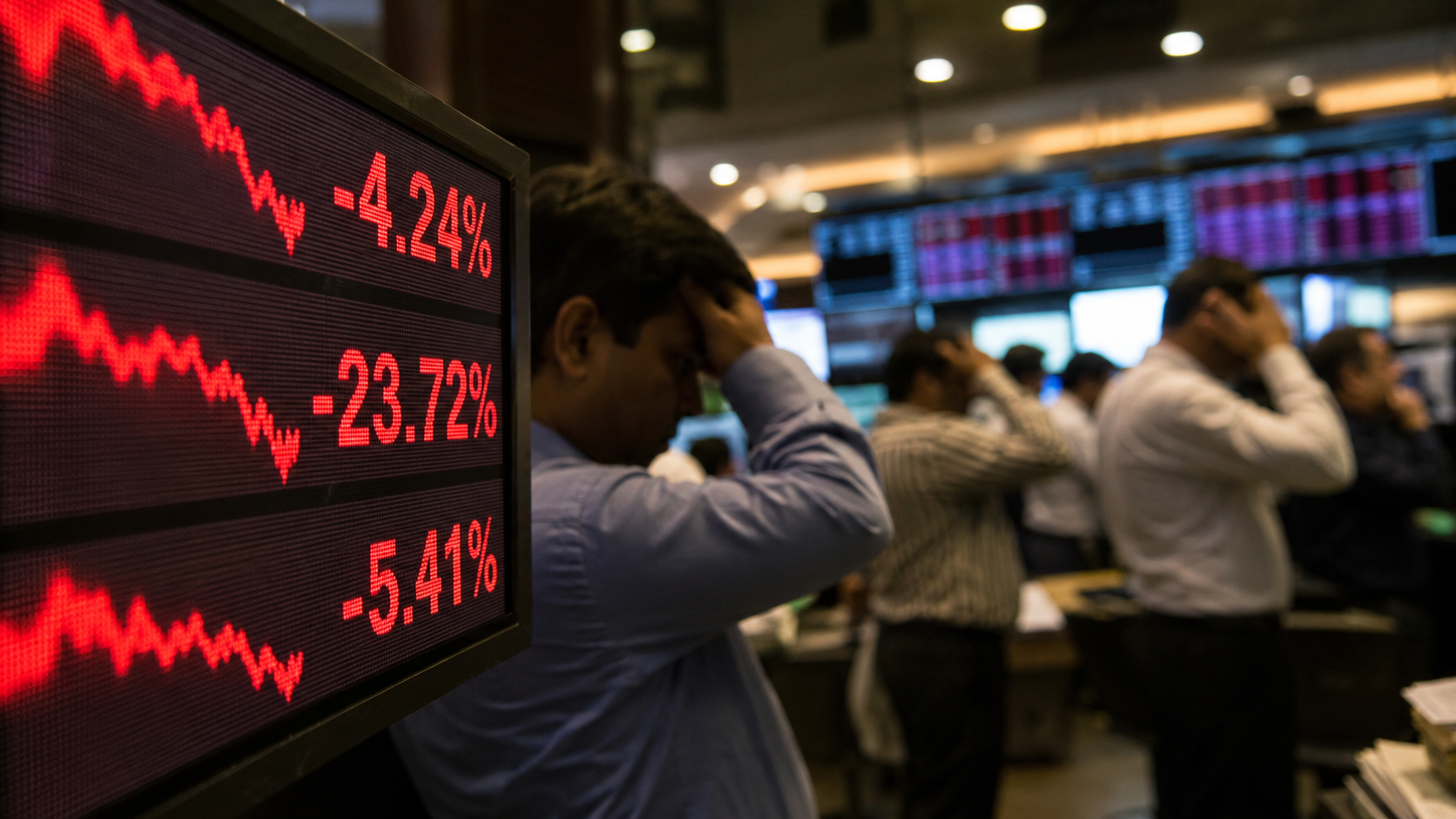
Read latest news online outlining the dramatic stock market crash on Dalal Street as the Nifty 50 slips below 24K and Sensex plunges 1,650 points.
Read Latest News Online: Massive Bloodbath on Dalal Street Exposes ₹8 Lakh Crore Investor Loss in Sudden Benchmark Plunge
A devastating wave of selling pressure completely gripped the Indian equity market today, triggering one of the most violent single-day corrections in recent months. The benchmark BSE Sensex collapsed by over 1,650 points from its previous close, while the Nifty 50 index slipped decisively below the psychological 24,000 threshold, suffering an intraday loss of 500 points. For investors seeking immediate financial clarity, they can read latest news online to track how a combination of deteriorating geopolitical events and macroeconomic friction instantly vaporized ₹8 lakh crore in investor wealth.
Key Developments
- Erosion of Wealth: The total market capitalization of BSE-listed companies plummeted from ₹480 lakh crore to ₹472 lakh crore in a matter of hours.
- Broad-Based Deficit: The market correction was overwhelmingly uniform, with 13 out of 16 major economic sectors logging severe intraday losses.
- Volatility Spikes: The India VIX, a key gauge of domestic market anxiety and risk sentiment, spiked by more than 5% as panic premium escalated.
Investigation Details
The heavy unwinding on Dalal Street caught retail and institutional investors off guard following a brief period of macro stabilization. Benchmark tracking data showed that the Nifty 50 experienced a sharp gap-down opening at 24,259 before bears aggressively pushed the index down to its final finishing point of 23,897. Similarly, the BSE Sensex experienced a severe opening gap down at 77,816, indicating instant systemic selling as trading commenced.
Sectoral tracking revealed that crude-sensitive domains absorbed the most severe damage. The domestic oil and gas index declined by 1.5%, closely trailed by the auto and fast-moving consumer goods (FMCG) segments, which fell by 1% and 1.5% respectively. High-volume market heavyweights, including Asian Paints, IndiGo, and ITC, emerged among the primary percentage losers. Conversely, defensive plays like pharmaceutical and healthcare shares gained a modest 0.5% as participants sought immediate sanctuary from broader macro disruption.
Official Statements
Financial strategists points to external factors as the primary catalysts shaking the foundation of domestic equities.
“With the renewed US-Iran tensions and the consequent spike in Brent crude to $76, the market is again back to uncertain territory. The market was slowly gaining strength on positive foreign inflows and improving macro fundamentals, but the latest flare-up in tensions has put a temporary question mark.” VK Vijayakumar, Chief Investment Strategist at Geojit Investments
Market analysts added that the upcoming corporate earnings for Q1FY27 are widely anticipated to look weak, forcing participants to actively discount performance metrics at higher valuation levels.
Top 5 Triggers Behind the Market Fall
1. Escalation of the US-Iran War
The foundational cause for the sudden selling pressure stems from escalating hostilities in the Middle East. Fresh military strikes executed by both the US and Iran have deeply complicated global safety corridors, instigating capital flight away from emerging risk assets.
2. Soaring Crude Oil Prices
As the world’s third-largest importer and consumer of oil, India remains highly vulnerable to supply disruptions. The sudden spike in Brent crude prices directly threatens to widen India’s import bill, stoke domestic inflation, and severely squeeze corporate profit margins.
3. Expectations of Weak Q1 Corporate Earnings
The prolonged geopolitical gridlock has taken a toll on the global economic canvas. Institutional equity analysts have warned that corporate financial metrics for the first quarter are hitting roadblock projections, prompting swift pre-emptive offloading.
4. Continuous Foreign Institutional Investor (FII) Outflows
Deteriorating global risk appetites, compounded by notable weakness in the Indian National Rupee (INR) against the US Dollar (USD), have triggered a massive exit by foreign fund managers. FIIs have maintained persistent net-selling positions, depriving the index of sustained support.
5. Surging Domestic Volatility Sentiments
The sudden shift in macro factors caused a massive realignment of risk perception. The rapid 5% surge in the India VIX metric reflects a fundamental shift toward capital preservation, sparking rapid profit-booking across previously overvalued sectors.
What Happens Next
Market analysts project continued near-term turbulence as the financial sector absorbs international updates. Institutional focus will shift heavily to currency defense strategies utilized by the Reserve Bank of India (RBI) to curb rapid rupee depreciation. Furthermore, the opening week of corporate financial declarations will provide critical concrete data on whether corporate earnings are deteriorating as severely as current global trends imply.
Related Articles:
- US Resumes Iran Strikes and Reinstates Oil Sanctions
- Charlie Kirk Murder Hearing Begins in Utah Court
- Delhi Newlywed Death Leads to Husband’s Arrest
- Does Marriage Guarantee Wealth? Viral Financial Myths Debunked
- ₹100 Crore Scam Hits Bahraich Dargah Over Missing Audit Records
- Faridabad Bizman Dies by Suicide, Blames Wife
- Allahabad HC Denies Relief in Nikah Halala Case
- House Help Arrested Over Fake Rape Blackmail in Dwarka
FAQ
How much money did investors lose in today’s stock market crash?
BSE-listed companies collectively lost approximately ₹8 lakh crore in total market capitalization during today’s intense sell-off session.
Why are crude oil prices affecting Indian stocks so heavily?
India imports the vast majority of its petroleum products. When global crude prices soar, it increases corporate operational expenses, threatens profit margins for paint, auto, and airline firms, and triggers domestic inflation concerns.
Which sectors managed to remain positive during the crash?
While 13 of 16 sectors closed in the red, the pharmaceutical and healthcare sectors managed to climb 0.5% as investors rotated funds into defensive, insulated industries.
What index tracking levels did Nifty and Sensex finish at?
The Nifty 50 closed down 500 points at 23,897, while the BSE Sensex plummeted over 1,650 points to end the session at 77,816.
For a deeper look into the macroeconomic factors shaking up Dalal Street, check out Sensex and Nifty Market Crash Analysis which breaks down the specific triggers impacting banking stocks and rising oil prices.
Follow Us On Social Media:
[stock market today, today stock market, nifty, sensex, sensex nifty stock market, stock market india, india stock market, indian stock market, us stock market, news, stock market news, news stock market, share market, what is stock market, world stock market, live stock market, stock market live, today stock market news, stock market today india, stock market news today, stock market today news, indian stock market today, india stock market today, us stock market today, global stock market, global market, iran, nifty today, world stock market today, nse, why stock market down today, nasdaq, stock market crash, why is stock market down today, why market is down today, why stock market is down today, indian stock market news, trump, japan stock market, us stock market news, iran war, sensex today, china stock market, stock market holidays, why stock market is falling, nifty 50, international stock market, bse, gift nifty, us stock market live]






4 comments