
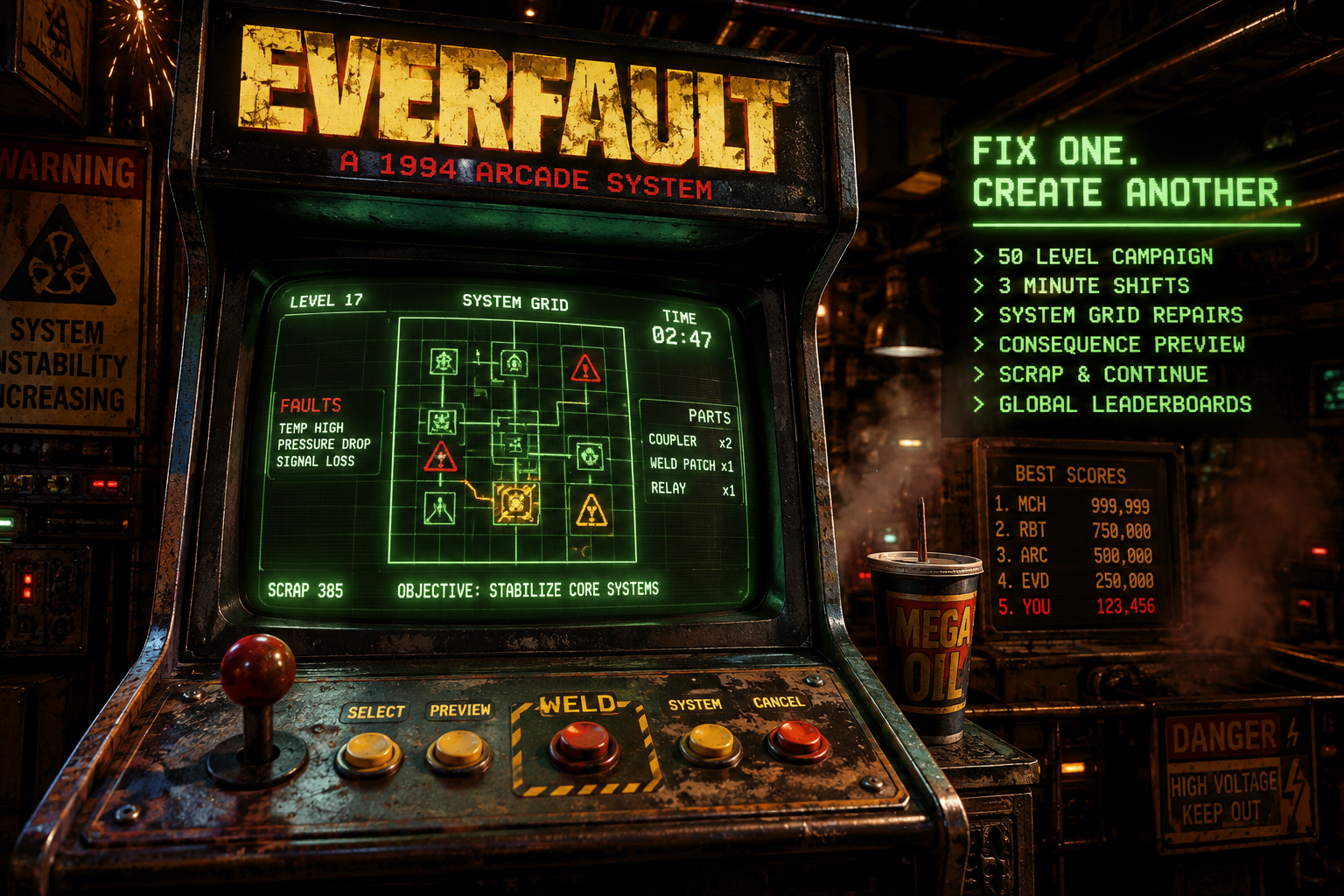
Discover EVERFAULT, a server-authoritative retro arcade game inspired by 1990s industrial games. Repair systems, manage faults, survive three-minute shifts and climb the leaderboard.
[everfault]
HOW TO PLAY EVERFAULT
Fix One. Create Another.
Welcome to EVERFAULT: a retro-industrial arcade game where every repair can create a new problem.
Your job is simple:
Diagnose the system. Repair the faults. Manage the consequences. Survive the shift.
But remember:
The system is always fighting back.
1. Start Your Shift
EVERFAULT requires a WordPress account.
Once you’re authenticated, select an unlocked level and start your session.
Every level is a three-minute shift.
The server starts your session, locks the appropriate level ruleset, generates the session state and controls the official timer.
Your browser displays the game, but the server decides what actually happens.
2. Understand the System Grid
The System Grid is the heart of EVERFAULT.
Your game state can contain multiple systems, including:
- Temperature
- Power
- Signal
- Pressure
You’ll also have an inventory of repair pieces.
Your objective is to stabilize the system and complete the level before the shift expires.
Watch the condition of the systems carefully.
A repair that solves one problem can affect another.
3. Find the Fault
When something goes wrong, identify the affected fault on the System Grid.
Use:
SELECT
to identify the fault or target you want to work on.
A fault must be valid and interactable before the server will accept the action.
Don’t rush into a repair.
First understand what you’re trying to fix.
4. Choose a Repair Piece
Once you’ve selected a fault, choose an available repair component from your inventory.
V1 can use different piece types, including:
- Line
- Corner
- Tee
- Cross
The available pieces depend on the level.
You cannot use a piece that isn’t in your inventory, and every placement must satisfy the level’s rules.
5. Place the Piece
Place your selected piece on the appropriate System Grid location.
The server validates:
- Whether the piece exists in your inventory
- Whether the location is legal
- Whether the action is valid
- Whether your action sequence is correct
If the placement isn’t legal, the repair won’t be accepted.
Think before you place.
Your available components are limited.
6. Preview the Weld
This is one of the most important steps in EVERFAULT.
Before committing a repair, use PREVIEW WELD.
The game calculates the expected consequences of the proposed repair.
The preview can show things such as:
- Target system changes
- Secondary system changes
- Weld duration
- Warnings
- Cascade risk
- Other resulting changes
EVERFAULT requires the consequence preview before a weld can be committed.
Never blindly weld.
Look at the consequences first.
A repair that appears helpful may create a more serious problem somewhere else.
7. Commit the WELD
If you’re satisfied with the preview, commit the repair.
WELD = COMMIT.
Once committed, the weld becomes an immutable action while the server resolves it.
The game then follows:
SELECT → PREVIEW → COMMIT → WELD LOCK → RESOLVE → CONSEQUENCE → ACTIVE
A committed weld cannot normally be cancelled.
V1 defaults to no cancellation unless a particular level explicitly permits it.
So make your decision carefully.
8. Watch the Consequences
After the weld resolves, the system changes.
Your repair can produce:
- A target-system improvement
- Secondary system changes
- Inventory changes
- A weld duration
- Cascade risk
- New faults
EVERFAULT is built around this principle:
Fix One. Create Another.
A successful repair isn’t necessarily the end of the problem.
It may simply move the problem somewhere else.
9. Manage Entropy
While you’re working, the system is deteriorating.
This is called Entropy.
Entropy is controlled by the server and evaluated using authoritative elapsed time, validated actions and the level’s configured rules.
Each level can define:
- Base decay
- Affected systems
- Tick interval
- Modifiers
- Thresholds
Entropy is deterministic for a given level version, seed, starting state and action history.
The longer you wait, the more dangerous the system can become.
Don’t waste your three-minute shift.
10. Watch for Cascades
When a system reaches its configured emergency threshold, the Cascade Engine evaluates what happens next.
A cascade can make your situation significantly worse.
The game communicates the event through visual, audio and CRT effects, while the underlying consequence remains determined by the server.
When you see a system approaching a critical threshold:
Act.
Don’t wait for the failure.
11. Manage the Three-Minute Timer
Every level starts with a server-controlled 180-second timer.
Your on-screen countdown is only a display of the authoritative server timer.
Network delays cannot give you extra time.
When the server timer reaches zero, your session becomes:
EXPIRED
The server decides when the shift has ended.
12. What Happens If You Fail?
Failure isn’t necessarily the end.
When a shift expires, you can be offered the option to continue.
If you have enough Scrap, you can use it to resume the session according to the configured continuation rules.
V1 defines:
| Continue | Scrap Cost |
|---|---|
| First Continue | 100 Scrap |
| Second Continue | 150 Scrap |
| Third Continue | 250 Scrap |
Continuation is limited by the level/session rules.
You can also choose to RESTART.
Restarting begins a fresh attempt.
Your previously completed campaign levels remain saved.
13. Learn From Failure
EVERFAULT doesn’t want you to simply lose.
It wants you to understand why you lost.
After failure, the game provides a short post-mortem showing the relevant cause and mistake.
Use it.
Ask yourself:
- Which system failed?
- Which repair caused the problem?
- Did I wait too long?
- Did I ignore a warning?
- Did I choose the wrong repair?
- Did a consequence trigger a cascade?
Then try again.
14. Complete the Level
To complete a level, you must satisfy its configured objective.
The server determines whether the objective has actually been achieved.
When the objective is satisfied, the server generates the FINISH action and finalizes the result.
A successful completion can update:
- Level completion
- Stars
- Best score
- Best time
- Clean-run status
- Progression
- Scrap rewards
- Leaderboard eligibility
15. Earn Scrap
Scrap is EVERFAULT’s in-game currency.
V1 defines:
Base Level Clear: +100 Scrap
Efficiency Bonus: +25 to +50 Scrap
Scrap can also be spent on continuation.
Every Scrap change is recorded in the server-side ledger.
Important:
Scrap cannot directly buy campaign progression.
Scrap also cannot directly buy leaderboard rank.
16. Earn Stars and Improve Your Best Result
Completing a level isn’t necessarily enough.
You can improve your performance by achieving better results under the server’s scoring rules.
The scoring model can consider:
- Completion
- Stars
- Efficiency
- Clean runs
- Time/performance
- Continues
- Configured penalties
Purchased Scrap and money spent have zero direct scoring value.
That means:
Skill beats spending.
17. Unlock the Next Level
EVERFAULT contains a 50-level campaign.
The next level becomes available only after authoritative completion of the previous level.
For example:
Complete Level 1 → Level 2 unlocks
Complete Level 2 → Level 3 unlocks
And so on.
Previously completed levels remain saved to your account.
18. Climb the Leaderboard
EVERFAULT includes four leaderboard periods:
WEEKLY
A short competitive race that resets each week.
MONTHLY
A longer competition focused on sustained performance.
YEARLY
A prestige ranking for long-term performance.
ALL-TIME
The permanent record.
The server calculates leaderboard scores from your validated gameplay results.
You cannot simply submit your own score.
Purchased Scrap cannot directly increase your ranking.
19. Your Basic Gameplay Loop
Once you understand the system, your normal shift becomes:
① FIND
Locate the active fault.
② SELECT
Select the fault you want to repair.
③ PLACE
Choose and place an appropriate repair piece.
④ PREVIEW
Check what your repair will change.
⑤ WELD
Commit the repair.
⑥ WATCH
Observe the system response.
⑦ ADAPT
React to new faults and consequences.
⑧ STABILIZE
Keep the system away from critical thresholds.
⑨ COMPLETE
Satisfy the level objective.
⑩ IMPROVE
Replay to improve your score, stars, time and leaderboard position.
20. The Golden Rules
Remember these rules every time you play:
RULE 1 — Watch the clock.
You have three minutes.
RULE 2 — Don’t weld blindly.
Always check the consequence preview.
RULE 3 — Watch every system.
Fixing one problem can create another.
RULE 4 — Respect entropy.
The system continues deteriorating while you play.
RULE 5 — Watch critical thresholds.
A cascade can turn a manageable situation into a crisis.
RULE 6 — Your inventory matters.
Use your available repair pieces wisely.
RULE 7 — Learn from failure.
The post-mortem tells you what went wrong.
RULE 8 — Scrap is a resource.
Use it strategically.
RULE 9 — Skill determines the leaderboard.
Buying Scrap doesn’t buy rank.
RULE 10 — Try again.
Every failed shift is information for the next one.
THE EVERFAULT MINDSET
Don’t ask:
“How do I fix this one fault?”
Ask:
“What happens after I fix it?”
That’s the difference between surviving a shift and causing a meltdown.
The system is connected.
Every action has consequences.
Every second matters.
Every weld changes the board.
FIX ONE.
CREATE ANOTHER.
SURVIVE THE SHIFT.
EVERFAULT Brings a New Kind of Retro Game to Modern Players
The world of retro games is bigger than ever.
Players who grew up with arcade machines, Game Boy Color, classic consoles and early PC games are now joined by a new generation discovering retro video games, handheld emulation and minimalist arcade design.
But what if a new game could capture the feeling of a lost 1990s arcade machine without simply copying an old game?
That is the idea behind EVERFAULT.
EVERFAULT is designed as a fictional lost 1994 industrial arcade game: approximately 70% arcade, 20% industrial terminal and 10% CRT nostalgia. Its central philosophy is straightforward: gameplay clarity comes before atmosphere, lore, visual effects and monetization.
Instead of fighting opponents or collecting traditional power-ups, players become technicians responsible for repairing an increasingly unstable industrial system.
Every shift lasts three minutes.
Every repair matters.
And every mistake can create another problem.
What Is EVERFAULT?
EVERFAULT is a 50-level retro industrial arcade game built around short, intense three-minute gameplay sessions.
The player diagnoses faults, manipulates a System Grid, selects repair components, previews the consequences of a repair and then commits a WELD action.
The server—not the browser—controls the authoritative game state.
That means progression, Scrap, completed levels and leaderboard scores cannot simply be modified by changing browser data. The game’s technical specification explicitly establishes the browser as a “dumb terminal” while the server remains the authoritative game brain.
This design gives EVERFAULT something increasingly rare in modern casual and online games:
A simple idea with meaningful consequences.
Why Retro Games Still Matter
The popularity of retro games isn’t only about nostalgia.
Classic games often worked because they understood a fundamental rule of game design:
Give the player a clear objective, understandable controls and an immediate reason to try again.
That philosophy can be found across generations of games.
From Snake game classics to arcade machines, from Game Boy Color titles to fighting games such as Tekken 3, from early console games to modern indie retro-inspired projects, the appeal is often rooted in accessibility.
A player doesn’t necessarily need a 100-page tutorial.
They need to understand:
What do I do?
Why did I fail?
What can I do differently next time?
EVERFAULT makes that philosophy one of its governing principles. The specification requires players to understand what failed, why it failed and what they can do differently.
EVERFAULT vs Traditional Retro Arcade Games
EVERFAULT doesn’t attempt to reproduce a specific classic franchise.
It creates its own retro identity.
The game combines:
- Industrial terminal aesthetics
- CRT-inspired visuals
- System Grid gameplay
- Three-minute shifts
- Fault diagnosis
- Repair-piece placement
- Consequence previews
- WELD actions
- Entropy and system deterioration
- Cascading failures
- Scrap-based continuation
- Persistent progression
- Competitive leaderboards
The result is intended to feel like discovering a strange arcade cabinet that somehow survived from 1994.
It isn’t a ROM recreation.
It isn’t an emulator.
It isn’t a port of an existing retro game.
It is a new retro game built around an old-school arcade philosophy.
From Snake Game Simplicity to Industrial Strategy
Someone searching for a snake game, arrow puzzle, online chess, chess online, or simple free games may be looking for something very different from a large modern AAA video game.
But these searches reveal something important about casual gaming:
Players enjoy games that are immediately understandable.
Snake has a simple objective.
Chess has understandable pieces.
A puzzle has recognizable rules.
EVERFAULT applies the same accessibility principle to an industrial repair system.
You see a fault.
You select the relevant system.
You choose a repair.
You preview what could happen.
Then you decide whether to commit.
The complexity comes from the consequences, not from hiding the rules.
A Three-Minute Retro Game Challenge
One of EVERFAULT’s defining mechanics is the three-minute shift.
Every level is built around a server-controlled 180-second duration. The client displays the countdown, but the server determines when the session actually expires. Network delay cannot extend the session.
That creates an arcade-style pressure loop:
Diagnose → Repair → Observe → Adapt → Survive
Three minutes may sound short.
That’s intentional.
The goal is to create a game that can be played during a quick break while still offering enough depth to encourage another attempt.
The System Grid Is the Heart of EVERFAULT
At the center of the gameplay experience is the System Grid.
Players interact with faults and repair components rather than simply moving a character through a conventional level.
The authoritative game state tracks systems such as:
- Temperature
- Power
- Signal
- Pressure
It also tracks the player’s available repair inventory, faults, objective, continuation usage and other session information.
A repair can therefore solve one problem while creating another.
That is where EVERFAULT’s central philosophy comes from:
Fix one. Create another.
A successful repair isn’t necessarily the end of the problem.
It may change system conditions, consume inventory, introduce risk or trigger another fault.
WELD: The Signature EVERFAULT Mechanic
The primary interaction in EVERFAULT is WELD.
Before a player commits to a weld, the game uses a structured sequence:
SELECT → PREVIEW → COMMIT → WELD LOCK → RESOLVE → CONSEQUENCE → ACTIVE
The player first identifies a target.
Then the game generates a consequence preview.
The player commits the repair.
The weld becomes temporarily locked while the server resolves it.
Finally, the resulting system changes become part of the authoritative state.
This makes WELD more than a button.
It becomes the game’s risk/reward decision.
Why Consequence Preview Matters
Many games hide their calculations behind animations and effects.
EVERFAULT takes a different approach.
Before a weld is committed, the player must receive a consequence preview.
The preview can communicate:
- Target system changes
- Secondary system changes
- Weld duration
- Warnings
- Potential cascade risk
The technical specification explicitly requires every repair to have an identifiable target effect and one or more consequences, with the same rules driving the preview, authoritative resolution, animation, audio and post-mortem.
That means the player isn’t supposed to lose because the game secretly changed the rules.
The player loses because the system became difficult to manage.
And then the game explains what happened.
Retro Arcade Meets Modern Online Game Architecture
At first glance, EVERFAULT may sound like an old-school retro arcade game.
Technically, however, its architecture is designed for a modern online environment.
The game is implemented as a WordPress plugin with a server-side game session service, validation engine, progression service, Scrap ledger, leaderboard service, WooCommerce bridge, level configuration and telemetry.
That architecture matters because online games create different problems from offline arcade machines.
A player can refresh a browser.
A connection can disappear.
A request can be duplicated.
A client can attempt to submit an invalid score.
EVERFAULT is designed around these realities.
Retro Games Online Without Trusting the Browser
The phrase retro games online often brings to mind browser-based versions of classic games.
EVERFAULT uses the browser too—but with a critical distinction.
The browser renders the experience.
The server decides what actually happened.
The specification requires server-side validation for gameplay actions, progression, Scrap, scores and completed levels.
Actions such as selecting faults, placing pieces, previewing welds, committing welds, continuing after expiration and restarting sessions are validated by the server.
This makes EVERFAULT closer to a server-authoritative online game than a conventional JavaScript-only browser game.
What About Emulators, RetroArch and Retro Handhelds?
Players searching for emulator, RetroArch, Batocera, R36S, Retroid Pocket 2, Retroid Pocket 3, Retroid Pocket 4, Retroid Pocket 4 Pro, Miyoo Mini Plus, Analogue Pocket, or the best retro handheld are part of a growing retro-gaming audience.
These devices and platforms have helped make classic gaming portable and accessible.
A retro gaming setup today might include:
- A retro handheld
- A mini game console
- A modern console such as Nintendo Switch
- An emulation-focused operating system
- RetroArch
- Batocera
- Original hardware
- PC gaming through Steam
- Browser-based retro games
EVERFAULT approaches the same audience from another direction.
Rather than asking players to find an old ROM or configure an emulator, its experience is designed as a new game with a deliberately retro presentation.
EVERFAULT and the Modern Retro Handheld Audience
The popularity of devices such as the Miyoo Mini Plus, Retroid Pocket 4, Retroid Pocket 4 Pro, R36S, Retroid Pocket 3, Retroid Pocket 2 and Analogue Pocket shows how strongly players continue to value portable gaming.
The appeal isn’t necessarily about graphics.
It is about immediacy.
Pick up the device.
Launch the game.
Start playing.
EVERFAULT’s three-minute shift structure is designed around a similar philosophy.
You don’t need to dedicate an entire evening to one session.
You can start a shift, attempt to stabilize the system and then decide whether you’re good enough to try again.
From Game Boy Color to Modern Retro-Inspired Games
The Game Boy Color represents an important era in portable gaming.
Its limitations encouraged developers to prioritize mechanics over spectacle.
Modern retro-inspired games can take that philosophy while using considerably more capable technology.
EVERFAULT’s visual identity deliberately combines industrial-terminal design with subtle CRT effects. Stable, warning, critical and emergency states can alter visual and audio intensity, while reduced-motion settings can disable heavy flicker, shake and aggressive glitch effects.
The result is retro-inspired presentation without requiring retro hardware.
EVERFAULT Is Not Pay-to-Win
Modern games often create controversy around monetization.
EVERFAULT takes a specific approach to its in-game currency: Scrap.
Scrap can provide continuation and convenience and can be used for optional cosmetics, but it cannot directly purchase campaign progression or leaderboard position.
The V1 economy specifies:
- Level clear: +100 Scrap
- Efficiency bonus: +25 to +50 Scrap
- First Continue: -100 Scrap
- Second Continue: -150 Scrap
- Third Continue: -250 Scrap
Campaign unlocks cannot be purchased, and leaderboard rank cannot be purchased.
That distinction is important.
Buying Scrap can provide convenience.
It cannot simply buy mastery.
Leaderboards for Retro Game Fans
EVERFAULT isn’t only about completing levels.
It also includes competitive rankings.
The V1 specification defines four leaderboard periods:
Weekly
Monthly
Yearly
All-Time
The server calculates leaderboard scores from validated gameplay results. Players cannot simply submit their own score.
That makes the competitive system closer to an arcade scoreboard than a traditional social-media ranking.
You play.
You improve.
You climb.
What Determines an EVERFAULT Score?
The scoring model is centralized on the server and versioned.
The recommended structure combines:
- Completion value
- Star value
- Efficiency
- Clean-run bonus
- Continue penalties
- Other configured penalties
Purchased Scrap, money spent and Scrap balance have zero direct scoring value.
That means the leaderboard is intended to reward performance, not spending.
Failure Is Part of the Game
EVERFAULT is designed around failure.
But failure isn’t supposed to feel arbitrary.
When the player loses, the game should explain the cause and identify the relevant mistake.
The V1 acceptance criteria specifically require failure to clearly identify the cause and last relevant mistake.
This is one of the biggest differences between a simple free game and a game designed around mastery.
Failure becomes information.
The next attempt becomes an experiment.
And the player gradually learns how the industrial system behaves.
From Free Games to “One More Try”
The internet is full of searches for free games, online games, Poki games, Poki game, Crazy Games, Unblocked Games 66, games online, game vui, and other quick-play experiences.
Those platforms demonstrate the enormous demand for games that can be started immediately.
EVERFAULT takes the quick-session concept but adds persistent progression.
A three-minute shift can become:
One attempt.
Then:
One more attempt.
Then:
One more level.
The game’s 50-level campaign is designed as a progression rather than a collection of disconnected browser games.
Retro Arcade Design Without Copying Classic Games
There is a difference between a retro game and an old game.
An old game was actually released decades ago.
A retro game can be a modern title intentionally designed around older aesthetics, mechanics or design principles.
EVERFAULT belongs to the second category.
It is designed to evoke a fictional lost 1994 industrial arcade experience.
That means fans of retro games, retro video games, retro arcade games, retro handhelds, retro consoles and classic video games can recognize the visual language without EVERFAULT pretending to be a historical arcade title.
How EVERFAULT Fits the Broader Gaming Search Landscape
Gamers search for thousands of different experiences.
Some look for:
- Snake
- Snake game
- car games
- car games online
- car racing games
- online chess
- chess online
- typing game
- arrow puzzle
- bingo game
- bingo
- imposter game
- Daman game
- Poki games
- Poki game
- GTA Vice City
- Tekken 3 online
- Retro Bowl
- Family Feud
- mini game console
- retro games online
- retro arcade
- free games
Others search specifically for hardware:
- best retro handheld
- retro handheld
- retro game console
- R36S
- Retroid Pocket 4
- Retroid Pocket 4 Pro
- Miyoo Mini Plus
- Analogue Pocket
- Nintendo Switch
- Nintendo Switch OLED
- Game Boy Color
And others are looking for platforms, stores or software:
- Steam
- RetroArch
- Batocera
- GameStop
- AliExpress
- retro games online
- emulator
EVERFAULT does not need to be every one of these things.
Its opportunity is to become something recognizable within the same broad gaming culture:
a new retro-inspired arcade game with its own identity.
Why EVERFAULT Could Appeal to Retro Gaming Communities
The strongest retro gaming communities tend to value three things:
Immediate gameplay
You should understand the basic objective quickly.
Replayability
A completed game should make you want to improve your performance.
Identity
A game should have an aesthetic and mechanic that people can recognize.
EVERFAULT’s design is deliberately built around all three.
The Level 1 vertical slice is required to prove the core loop before the full 50-level campaign expands. The specification requires authentication, the main terminal, Level 1 configuration, a three-minute timer, System Grid interaction, inventory, consequence preview, WELD resolution, entropy, failure/post-mortem, restart, continue, completion, rewards, persistence, audio, CRT rendering, mobile layout and leaderboard ingestion.
A Retro Game Designed for Desktop and Mobile
Mobile isn’t treated as an afterthought.
The V1 design explicitly states that mobile is a dedicated composition rather than a compressed desktop interface.
This is important for modern browser gaming.
Players may discover a game on desktop and later return from a phone.
EVERFAULT’s interface therefore needs to remain usable without relying on desktop-sized controls or information density.
What Makes EVERFAULT Different?
The simplest description is:
EVERFAULT is a three-minute industrial survival puzzle disguised as a lost 1994 arcade machine.
But beneath the retro presentation is a modern architecture.
The game has:
- Server-authoritative sessions
- Persistent player progression
- Versioned levels
- Validated actions
- Replay protection
- Idempotency
- Scrap accounting
- WooCommerce fulfillment
- Leaderboards
- Telemetry
- Mobile support
- Accessibility controls
- Failure analysis
- A 50-level campaign
These aren’t cosmetic additions.
They are part of the V1 engineering contract.
What About WooCommerce?
EVERFAULT is designed as a WordPress plugin, with WooCommerce handling real-money purchases.
The important distinction is that WooCommerce verifies the purchase while EVERFAULT controls the Scrap ledger.
A payment-success flag supplied by the browser is never trusted.
The server verifies the order, product, quantity, payment state and fulfillment state before crediting Scrap. Duplicate webhook deliveries must not create duplicate credits.
This allows the game to integrate commerce without making the browser responsible for the game’s economy.
Is EVERFAULT an MMO?
No.
Although searches for massively multiplayer online game represent a major gaming category, EVERFAULT V1 is not designed as an MMO.
Real-time multiplayer, chat, guilds, clans, PvP and player-to-player Scrap trading are explicitly outside the V1 scope.
EVERFAULT is instead focused on an individual player’s campaign, mastery and leaderboard competition.
The Future of Retro-Inspired Online Games
The retro gaming audience is no longer limited to people who own original consoles.
Today, players can encounter retro gaming through:
- Dedicated handhelds
- Mini consoles
- PC emulators
- Retro operating systems
- Digital storefronts
- Browser games
- Modern consoles
- Indie games
- Remastered classics
- New retro-inspired games
That creates room for new experiences.
EVERFAULT’s approach is not to recreate the past exactly.
It is to ask:
What would a forgotten industrial arcade game from 1994 look like if it were rebuilt for today’s web?
From Level 1 to a 50-Level Campaign
EVERFAULT V1 contains 50 campaign levels.
But the development philosophy is deliberately different from simply producing 50 levels immediately.
The technical specification establishes Level 1 as the mandatory vertical slice and requires the core loop to prove itself before campaign expansion. The planned development chain is:
Design Bible → Technical Specification → Vertical Slice → Playtest → Balance → Campaign Expansion → Production V1.
That approach matters because the quality of a retro arcade game depends heavily on the quality of its core loop.
If repairing one fault isn’t satisfying, adding 49 more levels won’t solve the problem.
The Retro Arcade Game to Watch
The gaming industry doesn’t need another clone of an existing classic.
It doesn’t need another game pretending to be Snake.
It doesn’t need another generic retro game with pixel art pasted over modern mechanics.
It needs new games that understand why classic games were memorable.
EVERFAULT takes that challenge seriously.
Its identity is built around:
Three minutes.
One industrial system.
Multiple faults.
Limited resources.
Consequences.
One more attempt.
The result is intended to feel less like browsing through another list of online games and more like discovering a strange arcade cabinet that should not exist—but somehow does.
Frequently Asked Questions
Is EVERFAULT a retro game?
Yes. EVERFAULT is designed as a fictional lost 1994 industrial arcade game, combining arcade gameplay, industrial terminal aesthetics and CRT nostalgia.
Is EVERFAULT an online game?
Yes. V1 is designed as a WordPress-based online game with server-authoritative sessions, persistent progression and online leaderboards.
How long does an EVERFAULT level take?
Each campaign level uses a three-minute, or 180-second, server-controlled shift.
How many levels does EVERFAULT have?
V1 contains a 50-level campaign.
What is WELD in EVERFAULT?
WELD is the game’s primary repair interaction. A player selects a fault, previews the consequences, commits the repair and then waits for authoritative resolution.
Does EVERFAULT have leaderboards?
Yes. V1 includes weekly, monthly, yearly and all-time leaderboards.
Can players buy leaderboard rank?
No. Purchased Scrap cannot directly increase leaderboard score.
Is EVERFAULT pay-to-win?
The V1 economy is specifically designed so that campaign progression and leaderboard rank cannot be directly purchased.
What happens when the timer reaches zero?
The server freezes the session and transitions it to an expired state. Depending on the configured rules, the player can use Scrap for a continuation or restart.
Does EVERFAULT use an emulator?
No emulator is required by the V1 specification. EVERFAULT is a new web-based retro-inspired game rather than an emulator for existing retro games.
Is EVERFAULT available on R36S, Miyoo Mini Plus, Retroid Pocket 4 or Analogue Pocket?
The V1 specification does not establish native support for those specific handheld devices. The game is designed as a WordPress web experience with dedicated desktop and mobile compositions.
Is EVERFAULT an MMO?
No. Real-time multiplayer and MMO-style systems are outside the V1 scope.
Can I play retro games online without downloading an emulator?
EVERFAULT itself is designed as an online web game, so its retro-inspired experience does not depend on an emulator.
What makes EVERFAULT different from other retro games?
Its central mechanic is industrial fault management. Instead of simply fighting enemies or collecting objects, players must diagnose problems, place repair components, preview consequences and make high-pressure WELD decisions.
A Different Kind of Retro Game
The retro gaming revival has created an enormous ecosystem around classic games, handheld consoles, emulators, mini consoles and online gaming.
But nostalgia doesn’t have to mean repetition.
EVERFAULT takes the visual language of retro games, the immediacy of retro arcade design and the replayability of classic video games, then builds a completely new gameplay loop around industrial repair and escalating consequences.
It is a game about making decisions under pressure.
A game where every repair can change the situation.
A game where failure teaches.
A game where three minutes can feel much longer.
And a game built around one simple philosophy:
Fix One. Create Another.
That is EVERFAULT.
Explore more Confession Stories here
Follow Us On Social Media: