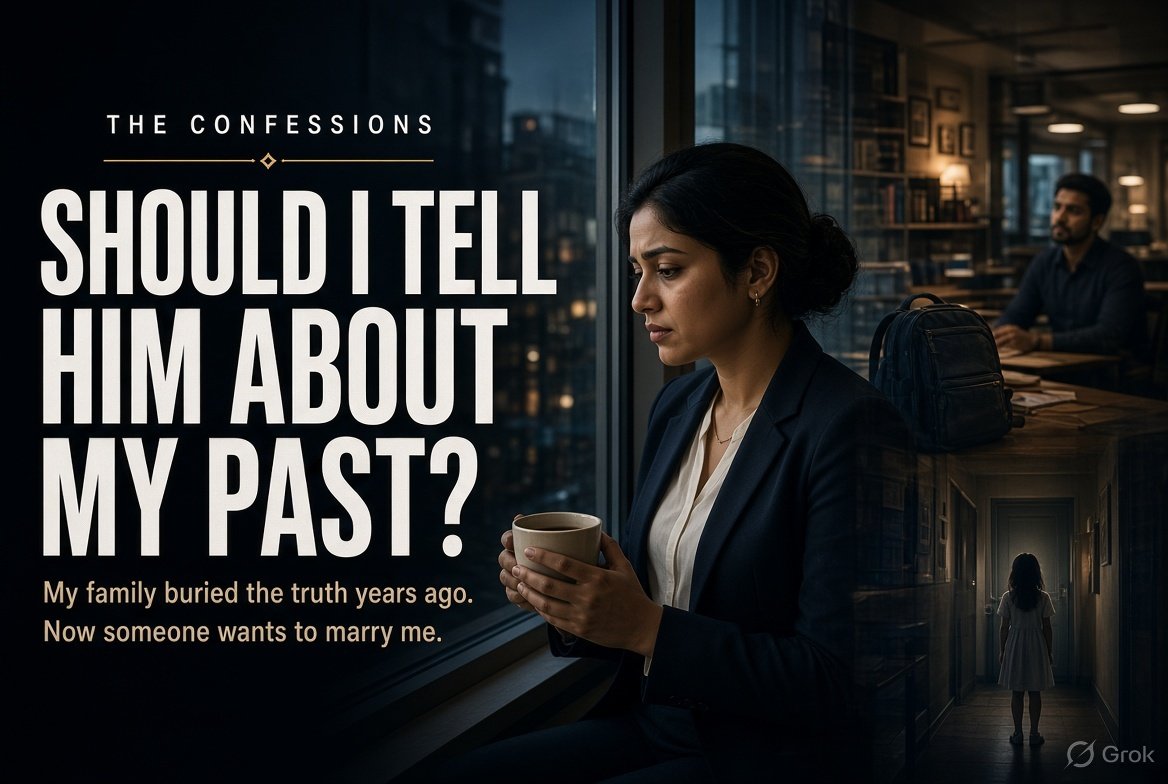
After my father’s death, my mother believed sending me to relatives in Delhi would protect my future. Instead, I came home carrying a secret my family taught me to bury, and now someone wants to build a future with me.
The Question I Wasn’t Ready For
“Can I ask you something serious?”
He said it so casually that I almost smiled.
We were sitting in the office cafeteria after most people had left for the day. Someone had abandoned a paper cup beside the microwave. The cleaning staff were stacking chairs at the other end of the room, and my laptop bag was already on my shoulder because I had been trying to leave for the last ten minutes.
I thought he was going to ask whether I wanted coffee.
Instead, he looked at me and said:
“Would you ever consider marrying me?”
I stared at him.
Not because I didn’t understand.
Because I did.
And because the first person who entered my mind was not him.
It was my cousin.
Then I remembered a bedroom in Delhi.
A locked door.
My own frightened voice.
My uncle’s face afterward.
And the sentence that had followed me into adulthood:
“Don’t tell anyone about this.”
The man sitting across from me knew none of it.
He knew the version of me that went to work every morning, complained about deadlines, shared lunch with colleagues and laughed when he sent me stupid memes during meetings.
He did not know the girl I had been in Class 8.
He did not know why certain kinds of physical closeness sometimes made me uncomfortable.
He did not know why I hated family conversations about a girl’s “character.”
He did not know that the secret I was expected to protect was never really mine.
Now he was asking me to share a life with him.
And I had no idea whether sharing a life also meant telling him everything that had happened before he entered it.
Also read: Discovering My Wife Cheated on Me 6 Years Ago
After Papa Died, Everyone Started Making Decisions for Us
My father died of kidney failure when I was in Class 8.
There are parts of his illness I remember clearly and parts that have blurred together.
I remember medicine strips on a shelf.
I remember adults discussing money in voices that became quieter whenever one of us children entered the room.
I remember my mother pretending she wasn’t tired.
Most of all, I remember how quickly our family changed after he died.
We were three siblings, and I was the eldest.
Being the eldest did not suddenly make me mature. I was still a schoolgirl. I still worried about exams, notebooks, friendships and whether teachers would ask questions I hadn’t prepared for.
But adults began speaking to me differently.
“You have to understand your mother’s situation.”
“You’re the eldest now.”
“You have to be responsible.”
I heard variations of those sentences so often that I started believing grief itself was something I needed to behave properly around.
My mother had three children and a household to manage without my father. Money mattered. Education mattered. Every decision seemed connected to both.
That was when my tauji offered to help.
He lived in Delhi with my taiji and their son. My cousin was much older than me and had recently started his first year of engineering.
My tauji told my mother that I could stay with them and continue my studies.
To my mother, it probably sounded like one problem had been solved.
A safe home.
Relatives.
Better educational opportunities.
One fewer child’s daily expenses.
And, most importantly, family.
I don’t remember being properly asked what I wanted.
Perhaps I was. Perhaps I simply didn’t know that saying no was an option.
I remember packing clothes into a bag while my mother repeatedly told me to behave well.
“Don’t trouble Tauji and Taiji.”
I nodded.
“Study properly.”
I nodded again.
Then she touched my head.
“They are doing a lot for us.”
That sentence stayed with me.
They are doing a lot for us.
Gratitude can become a very heavy thing when you are a child.
Also read: Overcoming Homelessness and Facing Narcissistic Family Behavior
Delhi Was Supposed to Be My Second Chance
The first few weeks were mostly ordinary.
That is important for me to say because when I remember that house now, my mind tries to paint everything that happened there in one colour.
But it wasn’t like that.
There were normal mornings.
School uniforms.
Breakfast.
Television in the evening.
My taiji telling me not to leave wet towels on the bed.
My tauji asking about my marks.
Calls home where my mother would ask:
“You’re studying properly?”
“Yes.”
“They’re taking good care of you?”
“Yes, Ma.”
And for a while, that answer was true.
My cousin was in engineering college and seemed impossibly grown-up to me.
He had a different life. College friends. Notes I couldn’t understand. Phone calls he would take in another room. Conversations about things that felt far beyond school.
I admired him.
Eventually that admiration became something else.
I had a crush on him.
Writing that sentence even now makes me uncomfortable because of what happened later.
For years, I wondered whether that childish feeling somehow made me responsible for what followed.
I know there is a difference now.
I didn’t understand it then.
A schoolgirl having a crush does not mean she understands adult intimacy. Admiring someone does not mean consenting to sexual contact. Feeling shy when someone speaks to you does not mean giving them permission to ignore your refusal.
But the adults around me would later blur those distinctions so completely that I spent years doing the same thing to myself.
At the time, my crush consisted of embarrassingly small things.
I noticed when he came home.
I listened when he talked about college.
If he teased me, I pretended to be irritated and then replayed the conversation later.
Nothing about it felt dangerous.
He was my cousin.
I was living in his parents’ house.
He was older.
And I trusted the structure around me even when I did not fully understand my own feelings.
Then my tauji and taiji went out of town.
Also read: Lessons from My Relationship with an SDE at XYZ
The Day the House Became Different
I don’t want to describe every physical detail of what happened.
I don’t think I need to.
What matters is that my cousin came into my room when his parents were away.
At first I did not understand what he intended.
Then I did.
I opposed him.
He continued.
I remember being frightened more clearly than I remember the sequence of events.
There is something strange about memory after fear. People sometimes imagine traumatic memories like recordings, perfectly preserved from beginning to end.
Mine isn’t like that.
I remember fragments.
The room.
His closeness.
Trying to resist.
My fear.
The realization that there was no adult in the house who could walk through the door and interrupt what was happening.
I remember becoming less focused on stopping him and more focused on getting through whatever was happening without making it worse.
That confused me for years.
Why hadn’t I fought harder?
Why hadn’t I screamed louder?
Why hadn’t I run?
Those questions became especially poisonous because I already knew I had once had a crush on him.
So I kept putting myself on trial.
Maybe I had encouraged him somehow.
Maybe I had smiled too much.
Maybe he thought I wanted it.
Maybe my fear had not looked enough like fear.
I was a child trying to assign adult meaning to my own reactions because the alternative was admitting that someone I trusted had crossed a boundary I did not consent to.
When it was over, I didn’t suddenly understand what to do.
There was no dramatic moment where I became certain of everything.
I was confused.
Ashamed.
Afraid of him.
Afraid of myself.
And terrified that someone would find out.
That last fear turned out to be justified.
Just not for the reason I expected.
My Uncle Found Out
I don’t want to invent the exact circumstances of how my tauji learned what had happened because even in my own memory, that period feels tangled.
What I remember clearly is the result.
The adults knew.
And suddenly I was no longer simply the girl whose father had died and who had come to Delhi to study.
I had become a problem.
I expected questions about what his son had done.
Instead, questions came toward me.
Why had I allowed this?
Had I encouraged him?
Why hadn’t I stopped it?
What had I been thinking?
I tried to explain.
“I told him no.”
The room went quiet.
I remember looking at the adults’ faces, searching for one expression that would tell me somebody understood.
Instead, the discussion kept circling back to me.
I was the younger one.
The schoolgirl.
The one dependent on their home.
Yet somehow I felt as though I were being questioned about something I had planned.
At some point I said:
“I was scared.”
I don’t remember receiving an answer that helped.
What I do remember is being told I would be sent home.
That terrified me in a completely different way.
My mother had trusted these people with me.
She had already lost my father.
She was struggling with three children.
What would happen if she believed I had caused trouble?
What would happen to my education?
What would happen to my siblings?
I had been taught that my job was to reduce my mother’s burden.
Now I was returning as another burden.
Also read: The Harsh Reality of Judging Someone Based on Virginity or Body Count
The Journey Home
I remember packing again.
The first time I packed for Delhi, the bag represented possibility.
The second time, it felt like evidence.
I kept wondering what my mother had been told.
Nobody explained it to me properly.
Adults discussed things around me rather than with me.
By then I understood one thing very clearly.
Silence was expected.
My tauji promised my mother that he would continue helping with household expenses.
I was young, but I understood the connection.
Money and silence had somehow entered the same room.
I don’t know whether my mother experienced it exactly that way. I don’t know everything she was told, everything she believed or every calculation she had to make while raising three children after losing her husband.
I only know what it felt like to me.
It felt like my family needed his help.
And if speaking created a conflict with him, then speaking could hurt everyone.
So I stayed quiet.
My mother asked me questions after I came home.
Not all at once.
Sometimes indirectly.
“Did something happen there?”
I would look away.
“There was some problem.”
“What problem?”
I couldn’t explain it.
Part of me desperately wanted her to understand without making me say the words.
Children sometimes expect adults to possess that ability.
I wanted her to look at me and simply know.
But life doesn’t work like that.
Eventually enough was understood that the subject became something we did not discuss.
And that silence became part of our household.
I Learned How to Become Normal Again
School continued.
That almost offended me.
There were homework assignments.
Exams.
Uniforms to wash.
Friends complaining about teachers.
People arguing over seats in class.
I had expected the world to look different because I felt different.
Instead, everything around me remained ordinary.
So I became ordinary too.
Or at least I learned how to look ordinary.
Years passed.
I studied.
I grew older.
My siblings grew older.
Our family’s financial situation changed gradually.
People stopped asking about why I had returned from Delhi.
My cousin continued with his life.
For a long time, I heard updates about him through relatives.
College.
Work.
Career.
Marriage.
Eventually, Australia.
Every update produced a feeling I struggled to name.
I wasn’t constantly angry.
That would almost have been easier.
Sometimes I felt nothing.
Sometimes I wondered whether he remembered what happened as often as I did.
Sometimes I wondered whether he remembered it completely differently.
That thought disturbed me most.
Perhaps, in his version, it had been mutual.
Perhaps my childish crush had allowed him to rewrite everything afterward.
Perhaps he had convinced himself that because I had once liked him, my fear did not matter.
I will never know what story he tells himself.
He eventually married and moved to Australia.
His life acquired the respectable milestones families like to announce.
A career.
A wedding.
A foreign country.
Mine did too, in its own way.
I completed my education and started working.
I built a life where nobody knew the girl from that Delhi house.
I thought that meant I had moved on.
Then a man at work began noticing me.
Also read: The Struggle Within: A Lonely Wife and the Temptation Unseen
The Colleague Who Kept Bringing Me Tea
It wasn’t dramatic.
That may be why I started liking him.
He didn’t pursue me with grand gestures.
We worked in the same office, and our friendship developed through small repetitions.
Lunch breaks.
Messages about work.
Occasional conversations after everyone else had left.
He remembered how I took my tea.
He once noticed I had skipped lunch during a deadline and left something on my desk without turning it into a performance.
I liked that.
He didn’t behave as though kindness created a debt.
For a long time, I kept him safely inside the category of colleague.
Then friend.
Then something I refused to name.
He would sometimes ask about my family.
I could answer most questions easily.
Three siblings.
Father died when I was young.
Mother raised us.
I studied away from home for a period.
That last part always made me careful.
Once he asked:
“You stayed with relatives in Delhi, right?”
My fingers stopped over my keyboard.
“For some time.”
“Did you like Delhi?”
I stared at the screen.
“Not really.”
He laughed softly.
“That’s the shortest review of Delhi I’ve ever heard.”
I smiled.
He changed the subject.
He had no idea that a harmless question had opened a room in my head I had spent years keeping locked.
That evening, I went home and thought about telling him.
I didn’t.
Then He Asked About Marriage
When he finally proposed the idea of marriage, he didn’t make a speech.
That was another reason I believed he was serious.
“I like you.”
I looked down at the table.
“I know.”
He smiled.
“Very confident.”
For a few seconds, everything felt normal.
Then he became serious again.
“I’m not asking you to answer today. But I don’t want to pretend I’m just being friendly anymore.”
I didn’t say anything.
“If you feel the same, I’d like us to think about this properly. Marriage, I mean.”
The word changed the atmosphere.
Marriage.
Not dating.
Not flirting.
Not seeing where things went.
Marriage meant families.
Questions.
History.
Intimacy.
Trust.
A shared bedroom.
And suddenly the past was sitting at the cafeteria table with us.
He noticed my silence.
“Did I make you uncomfortable?”
“No.”
That answer came too quickly.
He waited.
“Then what happened?”
I wanted to tell him.
For perhaps three seconds, I genuinely thought I would.
Instead I said:
“I just need some time.”
He nodded.
“Take it.”
Then, almost as if he sensed I needed an exit from the conversation, he stood up and picked up his phone.
“Come on. They’re going to lock us inside the office.”
I laughed.
I appreciated him for making the moment smaller.
But on the way home, one question kept returning.
If I loved him, did I owe him the truth?
Also read: The Struggle Within: A Lonely Wife and the Temptation Unseen
What Exactly Am I Supposed to Confess?
That question has bothered me because even the word confession feels wrong.
The Confessions are supposed to be things we admit because we did something.
What am I admitting?
That someone violated my boundaries when I was a child?
That I froze?
That I had once had a crush on him?
That my family chose silence?
That financial dependence made that silence easier?
None of those things feels simple enough to place inside one neat sentence.
And yet I understand why this feels like a confession.
Because shame doesn’t care who was responsible.
It attaches itself wherever it can.
For years, I treated my past as information that could lower my value if someone discovered it.
I imagined telling a future partner and watching his face change.
Maybe he would ask:
“Why didn’t you tell anyone?”
Maybe he would ask:
“Why did you stay there afterward?”
Maybe the question I fear most:
“But you said you liked him?”
How would I explain the difference between a schoolgirl’s crush and consent?
How would I explain that I opposed what happened and became afraid?
How would I prove a memory that exists mostly inside me?
And why should I have to prove it?
Those questions are the reason I have not yet told the man from my office.
But there is another reason too.
I like the way he sees me now.
I don’t want to watch sympathy replace affection.
I don’t want him to become careful around me.
I don’t want every disagreement we have in the future to somehow trace itself back to my past.
Most of all, I don’t want to become a story someone else carries about me.
I Finally Asked My Mother About Delhi
Recently, I spoke to my mother about that period more directly than I had in years.
We were at home doing something completely ordinary when I brought it up.
For a few seconds, she didn’t respond.
Then she asked:
“Why are you thinking about all that now?”
I told her there was someone at work.
Her expression changed immediately.
“Someone you like?”
I nodded.
Then I told her he had spoken about marriage.
My mother was quiet.
I asked the question I had really wanted to ask.
“Should I tell him?”
She didn’t answer immediately.
Finally she said:
“Why do you need to open something that happened so many years ago?”
I knew what she meant.
She wasn’t necessarily dismissing what happened.
She was afraid.
Afraid of how a man might react.
Afraid his family might learn.
Afraid an old secret might damage a future that had nothing to do with it.
I understood her fear because I had inherited it.
Still, I asked:
“What if he finds out later?”
She looked at me.
“From whom?”
I didn’t have an answer.
My cousin lives in Australia.
Years have passed.
There is no obvious reason this man would ever know.
I could marry him and perhaps never tell him.
That possibility should make the decision easier.
Instead, it makes me uncomfortable.
Because then I would once again be protecting a silence that other people created for me.
Also read: Paying the Price for Being an Excessively Handsome, Drop-Dead Gorgeous Man
The Secret Has Already Taken Enough From Me
I have started realizing that the question is not simply whether a future husband deserves to know my past.
It is whether I want a marriage where I must actively hide part of myself.
There is also a difference between privacy and secrecy.
I am allowed privacy.
I do not owe anyone every painful detail of my childhood.
I don’t have to provide dates, descriptions or explanations simply because someone wants to marry me.
But if the experience still affects how I respond to intimacy, family conversations or certain situations, then hiding it completely may create confusion between us later.
I could tell him only what I am comfortable telling him.
I could say something happened to me when I was younger.
That it involved someone I trusted.
That I did not consent.
That my family handled it badly.
That I don’t want to discuss every detail.
And then I could watch what he does with that information.
Not just what he says in the first thirty seconds.
What he does afterward.
Whether he respects the boundary.
Whether he interrogates me.
Whether he blames me.
Whether he treats me differently.
Whether he understands that surviving something does not make it my identity.
Perhaps that reaction would tell me something important before marriage.
That possibility frightens me too.
Because if his reaction is cruel, I could lose the future I have started imagining.
But maybe that is exactly why the conversation matters.
I Am Still Deciding How Much to Tell Him
I haven’t given him my answer yet.
He has not pressured me.
At work, things are mostly normal.
We still talk.
We still share tea.
Sometimes I catch him looking at me as if he is waiting for an answer, but he doesn’t ask.
That patience makes me want to trust him.
It also makes the risk feel larger.
There is one thing I understand differently now.
For years, I thought the darkest part of this story was what happened in that room.
It wasn’t.
The part that followed me longest was being made to feel that I carried responsibility for it.
I was a child.
I had a crush on someone older.
I opposed what he did.
I was frightened.
Those facts can exist together.
My younger self didn’t understand that.
The adults around her should have.
My cousin is married now and living in Australia. My tauji grew older. My siblings built their own lives. My mother survived years that once seemed impossible for us to survive.
And I became the woman sitting in an office cafeteria while a decent man asked whether I could imagine marrying him.
Perhaps I will tell him.
Not because I owe him a confession.
Not because my past makes me damaged goods that must come with a warning.
And certainly not because what happened belongs on some moral balance sheet before I am allowed to be loved.
I may tell him because I am tired of treating somebody else’s actions as my shame.
If I do, I think I will keep it simple.
I will tell him there is something from my childhood I have rarely spoken about. I will tell him someone in my family crossed a sexual boundary without my consent and that the adults who learned about it blamed me instead of protecting me.
Then I will stop.
I won’t defend the fact that I once had a crush.
I won’t provide evidence.
I won’t turn a painful childhood memory into an interview.
And I will let his response tell me what I need to know about the man asking to share my future.
For years, the sentence attached to that Delhi house was:
“Don’t tell anyone.”
Maybe the question in front of me now isn’t whether I should obey that sentence forever.
Maybe it is whether, for the first time, I get to decide who hears my story, how much they hear, and what it means.
Also read: A Night That Changed My Perspective: Navigating Unplanned Consequences
[Fantasy confession latest, fantasy confession stories latest, fantasy confessions latest, #confessionstories latest, real fantasy confession latest, confessions fantasy latest, confession fantasy latest, fantasy confession latest 2026, fantacy confession latest, real confession stories latest, confession of fantasy latest, confession fantasies latest, fantasy confessions hindi latest, story confessions latest, adult confessions]
Follow Us On Social Media: