Department of Justice Indicts Eight Conspirators Over Coordinated Threats Against University of Michigan Officials and Jewish Institutions
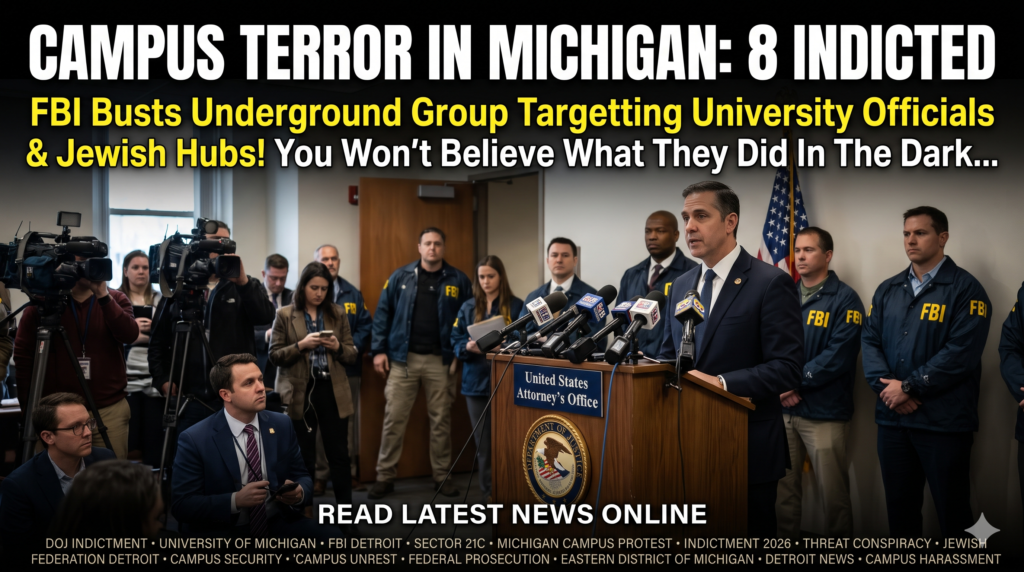
DETROIT, MICHIGAN: Federal prosecutors in the Eastern District of Michigan have unsealed a multi-count indictment charging eight individuals with orchestrating a sustained campaign of criminal threats, property destruction, and witness intimidation targeting University of Michigan administrators, law enforcement personnel, local businesses, and the Jewish Federation of Metropolitan Detroit. The sweeping federal indictment outlines how campus political activism allegedly crossed the threshold into coordinated unlawful intimidation across state lines.
For readers looking to Read Latest News Online regarding major federal legal developments and campus security enforcement in the United States, the Department of Justice announcement marks a pivotal moment in how federal authorities prosecute targeted harassment and property crimes linked to university divestment campaigns.
Direct Case Overview
- Prosecuting Jurisdiction: United States Attorney’s Office for the Eastern District of Michigan, announced by U.S. Attorney Jerome F. Gorgon Jr. alongside Federal Bureau of Investigation (FBI) leadership.
- Primary Defendants Indicted: Eight adults aged between 21 and 28 residing across Michigan, Illinois, and Wisconsin: Ahmet Kerem Korkaya (28), Alexander Matthew Sepulveda (23), Amatullah Aliasgar Hakim (21), Colin Hunter Weger (24), Jonathan Hongru Zou (22), Mariam Muhammed Odeh (24), Paige Elizabeth Feyock (26), and Zainab Aliasgar Hakim (23).
- Targeted Victims: University of Michigan Regents, former University President Santa Ono, the University Provost, a University of Michigan police lieutenant, an undergraduate student, two private businesses perceived to have commercial ties to Israel, and the Jewish Federation of Metropolitan Detroit.
- Core Federal Charges: Conspiracy to transmit interstate threats, witness intimidation, destruction of property to prevent seizure, and related federal offenses carrying maximum statutory penalties ranging from five to twenty years in federal prison per count.
- Alleged Modus Operandi: Nocturnal vandalism of private residences and offices, placement of simulated bloody corpses, throwing glass jars containing noxious chemical substances through residential windows, marking targets with symbols associated with militant groups, and amplifying the attacks online to coerce university financial divestment.
- Multi-Agency Task Force: Joint investigation conducted by FBI Detroit, FBI Chicago, FBI Milwaukee, the University of Michigan Department of Public Safety, Michigan State Police, the Michigan Intelligence Operations Center, and municipal police departments across southeastern Michigan.
Also Read: HS Phoolka Hits Out at Sonia Gandhi Over 1984 Riots Claims in Memoir
Background and Origin of the Investigation
The federal prosecution traces its origins to sustained campus unrest at the University of Michigan in Ann Arbor during 2024. Following the establishment and subsequent law enforcement clearance of a pro-Palestinian protest encampment on the university’s central Diag, demands intensified for the Board of Regents to divest the institution’s multi-billion-dollar endowment from companies conducting business with Israel.
While thousands of students and community members participated in lawful demonstrations, rallies, and public comment sessions, federal investigators documented a parallel, clandestine series of targeted attacks directed at the private homes and workplaces of decision-makers. According to court filings unsealed in Detroit, a core group of organizers allegedly concluded that conventional campus protests were insufficient to compel institutional divestment and subsequently formed a conspiracy aimed at terrorizing specific individuals into compliance.
Federal prosecutors stated in the indictment that members of the group explicitly drew inspiration from the Weather Underground, a radical domestic militant organization active in the late 1960s and 1970s. Investigators uncovered digital communications, planning records, and physical evidence indicating that the defendants coordinated reconnaissance, acquired supplies for nocturnal property attacks, and utilized encrypted messaging platforms alongside public social media accounts to broadcast their actions.
Breakdown of the Eight Indicted Defendants
The grand jury indictment filed in the U.S. District Court for the Eastern District of Michigan names eight defendants, most of whom were either enrolled students, alumni, or employees affiliated with the University of Michigan community at the time of the alleged offenses:
- Ahmet Kerem Korkaya (28), of Milwaukee, Wisconsin: Charged with participating in the overarching threat conspiracy and specific acts of targeted vandalism, including the attack on the Jewish Federation of Metropolitan Detroit.
- Alexander Matthew Sepulveda (23), of Chicago, Illinois: Accused of interstate coordination and participation in the conspiracy to transmit threats and intimidate university officials.
- Amatullah Aliasgar Hakim (21), of Ann Arbor, Michigan: Named in multiple counts involving residential vandalism, target marking, and conspiracy to coerce institutional leaders.
- Colin Hunter Weger (24), of Ann Arbor, Michigan: Charged with participating in coordinated property destruction, residential harassment, and witness intimidation efforts.
- Jonathan Hongru Zou (22), of Ann Arbor, Michigan: Alleged to have taken part in multiple nocturnal attacks, including the vandalism at the Jewish Federation of Metropolitan Detroit and university officials’ homes.
- Mariam Muhammed Odeh (24), of Dearborn, Michigan: Charged in connection with the conspiracy to transmit threats, coordinate harassment campaigns, and obstruct law enforcement inquiries.
- Paige Elizabeth Feyock (26), of Ann Arbor, Michigan: Named across counts detailing planned property damage, threatening messaging, and digital amplification of the attacks.
- Zainab Aliasgar Hakim (23), of Canton, Michigan: Accused of playing a central organizational role in multiple residential and institutional attacks documented in the indictment.
Following coordinated morning arrest operations executed by the FBI and local police in Michigan, Illinois, and Wisconsin, five of the defendants made their initial appearances before a federal magistrate judge in Detroit. Prosecutors sought detention pending detention hearings, citing the severity of the residential attacks and ongoing risks to community safety.
Also Read: The Persecution of Taraneh Alidoosti – Art, Defiance, and State Retaliation in Iran
Detailed Chronology of the Alleged Criminal Campaign
To understand the scope of the federal charges, prosecutors outlined a sequence of escalating incidents spanning several months across Ann Arbor, Bloomfield Hills, Southfield, and surrounding southeastern Michigan communities. Readers following this story as they Read Latest News Online can examine how the alleged conspiracy evolved from public demonstrations to covert nocturnal attacks:
- Spring 2024 (Campus Encampment and Initial Escalation): Demonstrators establish an encampment on the University of Michigan Diag demanding endowment divestment. Following police clearance of the encampment and disciplinary referrals, members of the alleged conspiracy begin identifying the private residential addresses of University Regents and senior administrators.
- May 2024 (Placement of Simulated Corpses and Residential Vandalism): Conspirators allegedly travel to the private residence of an elected University of Michigan Regent in the early morning hours, placing mock bloody corpses on the front lawn alongside threatening placards and spray-painted messages demanding divestment.
- June 2024 (Attacks on Private Businesses and Law Offices): Vandals target commercial properties and professional offices associated with university leadership and perceived supporters of Israel, including the Southfield law offices of Regent Jordan Acker. Properties and personal vehicles are defaced with red paint, broken glass, and political slogans.
- Summer 2024 (Noxious Chemical Jars Thrown into Provost’s Home): In one of the most severe incidents detailed by federal authorities, perpetrators approach the private residence of the University of Michigan Provost during nighttime hours while family members, including young children, are asleep inside. Two glass jars filled with a foul-smelling blue chemical substance are hurled through a residential window, shattering glass and contaminating the interior.
- Late 2024 (Vandalism of the Jewish Federation of Metropolitan Detroit): Five named defendants—Zainab Hakim, Amatullah Hakim, Paige Feyock, Ahmet Korkaya, and Jonathan Zou—allegedly conduct an overnight attack on the headquarters of the Jewish Federation of Metropolitan Detroit, defacing the building exterior with profanity, calls for “Intifada,” and threatening iconography.
- 2024 – 2025 (Digital Amplification and Witness Intimidation): Following each physical attack, photographs and videos of the damaged homes and institutions are uploaded to social media channels with explicit warnings that further escalation will follow unless divestment demands are satisfied. Conspirators also allegedly engage in witness intimidation and destroy digital devices to prevent federal seizure.
- June 10, 2026 (Federal Indictment Unsealed and Multi-State Arrests): The U.S. Attorney’s Office for the Eastern District of Michigan unseals the grand jury indictment, and FBI field offices across Detroit, Chicago, and Milwaukee execute simultaneous arrest warrants.
Specific Incidents and Symbols Cited by Federal Prosecutors
A central pillar of the Department of Justice’s case rests on the distinction between constitutionally protected political expression under the First Amendment and unlawful criminal intimidation. In detailing the physical evidence recovered at crime scenes, prosecutors highlighted specific tactics designed to instill fear of physical violence.
Residential Intrusions and Chemical Hazards
Unlike traditional campus protests conducted on public quads or outside administrative buildings, the indictment emphasizes that the defendants repeatedly targeted private family residences under the cover of darkness. At the home of then-University President Santa Ono, vandals spray-painted anti-Israel slogans and threatening messages across exterior surfaces. At the home of Regent Jordan Acker, both his private residence and personal automobile were vandalized with paint, accompanied by threats directed at his family.
Federal officials placed particular gravity on the attack against the University Provost’s home, where glass containers filled with noxious blue liquid were thrown through a windowpane. FBI Director Kash Patel noted in official remarks that launching glass projectiles filled with unknown chemical agents into an occupied home where children were sleeping demonstrated an acute disregard for human life and crossed squarely into violent criminal conduct.
Use of Militant Iconography
The indictment specifically documents that the conspirators marked victims’ homes, vehicles, and workplaces with red handprints and red inverted triangles. Federal prosecutors noted that the red inverted triangle is a symbol utilized by the militant organization Hamas in propaganda videos to designate targets for lethal strikes.
By painting these specific markers onto the front doors, driveways, and windows of Jewish community institutions, university leaders, and a University of Michigan student, the defendants allegedly sought to convey an unmistakable threat of physical harm. Immediately after executing these acts, the group disseminated images of the marked properties across internet platforms to maximize psychological pressure on both the immediate victims and the broader community.
Official Statements from Law Enforcement and Community Leaders
The unsealing of the indictment prompted forceful statements from senior federal prosecutors, law enforcement executives, and regional community organizations.
United States Attorney Jerome F. Gorgon Jr., who leads the Eastern District of Michigan, framed the prosecution as a defense of constitutional governance and public safety:
“In America, we rule by law, not by fear. These alleged threats and attempts to terrorize government officials, businesses, and the Jewish Federation are anti-American. We will counter intimidation with justice.”
FBI leadership echoed this assessment, underscoring the extensive interstate coordination required to assemble the case. Because suspects traveled between Ann Arbor, Dearborn, Chicago, and Milwaukee to plan and execute aspects of the conspiracy, FBI field offices in three states collaborated with the University of Michigan Department of Public Safety, the Michigan State Police, and the Michigan Intelligence Operations Center.
Representatives of the Jewish Federation of Metropolitan Detroit welcomed the federal charges, noting that the vandalism of their headquarters and the targeting of Jewish community members had generated deep anxiety across southeastern Michigan. University of Michigan officials similarly reaffirmed that while the institution remains committed to protecting peaceful free speech and academic debate, criminal vandalism, trespassing at private residences, and threats against employees and students will be met with full cooperation with law enforcement.
Defense Perspectives and Civil Liberties Debate
While federal authorities characterized the indictment as a necessary enforcement action against a violent criminal conspiracy, defense attorneys and campus activist groups have sharply contested the government’s framing.
Supporters of the indicted individuals gathered outside the Theodore Levin United States Courthouse in Detroit following the initial court appearances, carrying Palestinian flags and holding signs denouncing the prosecution. Several defense lawyers and civil liberties observers argued that federal prosecutors are sweeping politically motivated misdemeanor vandalism and protest activity into severe federal felony conspiracy statutes carrying decades of potential imprisonment.
Critics of the prosecution also pointed to earlier state-level proceedings in Washtenaw County, where local charges stemming from the 2024 Diag encampment were previously dismissed, questioning why federal authorities escalated the matter into a multi-state felony indictment two years later. Legal analysts note that a central battleground at trial will revolve around whether prosecutors can prove beyond a reasonable doubt that each individual defendant knowingly agreed to transmit true threats of violence, as defined by U.S. Supreme Court precedent, rather than engaging in protected, albeit controversial, political speech.
Also Read: The Confessions of a Trapped Soul: Part 1 — The Locked Room
Legal Framework: Federal Charges and Potential Penalties
Under Title 18 of the United States Code, the offenses alleged in the Eastern District of Michigan indictment carry substantial statutory penalties upon conviction:
| Federal Offense | Statutory Basis | Core Allegation in Indictment | Maximum Statutory Penalty |
| Conspiracy to Commit Federal Offenses | 18 U.S.C. § 371 | Coordinating across state lines to plan and execute threats, vandalism, and intimidation | Up to 5 years in federal prison |
| Interstate Transmission of Threats | 18 U.S.C. § 875(c) | Broadcasting threats to injure persons via social media and interstate internet platforms | Up to 5 years in federal prison per count |
| Witness Tampering and Intimidation | 18 U.S.C. § 1512 | Harassing individuals and attempting to deter cooperation with law enforcement | Up to 20 years in federal prison |
| Destruction of Property to Prevent Seizure | 18 U.S.C. § 2232 | Wiping or destroying electronic devices and physical evidence sought by investigators | Up to 5 years in federal prison |
Federal prosecutors emphasized in their press release that an indictment is merely a formal accusation of criminal conduct, and all eight defendants are presumed innocent unless and until proven guilty beyond a reasonable doubt in a federal court of law.
Broader Implications for Campus Governance and National Security
The University of Michigan prosecution reflects a broader national reckoning across American higher education regarding the boundaries between campus activism and targeted harassment. Over the past two years, university administrators, boards of trustees, and municipal leaders nationwide have grappled with how to safeguard institutional decision-makers when protests migrate from public campus spaces to private neighborhoods.
Security experts note that the deployment of federal resources—including FBI joint task forces and interstate communications subpoenas—signals a low tolerance by the Department of Justice for coordinated campaigns that utilize doxxing, residential vandalism, and militant iconography to influence public policy or university governance. Furthermore, subsequent developments in the Eastern District of Michigan investigation indicate that federal grand juries have continued examining wider networks connected to the alleged conspiracy, underscoring the long-term investigative commitment by federal authorities.
For journalists, legal observers, and citizens who Read Latest News Online to track major developments in federal law enforcement, the proceedings in the U.S. District Court in Detroit will serve as a closely watched test case on how federal conspiracy and threat statutes apply to modern, digitally amplified activist networks.
Also Read: “Sex for Rent” in Germany: How the Student Housing Shortage Fuels Exploitation
Frequently Asked Questions (FAQ)
Who are the eight individuals indicted by the Department of Justice in the University of Michigan case?
The eight defendants named in the federal indictment are Ahmet Kerem Korkaya (28) of Milwaukee, Alexander Matthew Sepulveda (23) of Chicago, Amatullah Aliasgar Hakim (21) of Ann Arbor, Colin Hunter Weger (24) of Ann Arbor, Jonathan Hongru Zou (22) of Ann Arbor, Mariam Muhammed Odeh (24) of Dearborn, Paige Elizabeth Feyock (26) of Ann Arbor, and Zainab Aliasgar Hakim (23) of Canton.
What specific crimes are the defendants accused of committing?
Federal prosecutors allege the defendants conspired to conduct a campaign of threats, vandalism, and intimidation aimed at forcing the University of Michigan to divest from Israel. Alleged acts include placing fake bloody corpses on a Regent’s lawn, throwing glass jars filled with noxious chemicals through the University Provost’s window, spray-painting militant symbols on homes and businesses, vandalizing the Jewish Federation of Metropolitan Detroit, and broadcasting threats online.
Who were the primary targets of the alleged conspiracy?
According to the U.S. Attorney’s Office for the Eastern District of Michigan, the targets included two University of Michigan Regents, former University President Santa Ono, the University Provost, a University of Michigan police lieutenant, an undergraduate student, two private businesses perceived to have ties to Israel, and the Jewish Federation of Metropolitan Detroit.
What are the potential prison sentences if the defendants are convicted?
Depending on the specific counts each defendant faces, the federal charges carry statutory maximum sentences ranging from 5 years in federal prison for conspiracy and transmitting interstate threats to up to 20 years in federal prison for witness intimidation.
Which law enforcement agencies investigated the case?
The investigation was conducted jointly by FBI field offices in Detroit, Chicago, and Milwaukee, alongside the University of Michigan Department of Public Safety, the Michigan State Police, the Michigan Intelligence Operations Center, and several local police departments in southeastern Michigan.
Also Read: ModelMarshal — Know the Cost. Control the Agent.
Follow Us On Social Media:
[Read Latest News Online, DOJ indictment university of Michigan, University of Michigan FBI arrests, Michigan 8 indictments FBI, Eight indicted University of Michigan threats, US Attorney Eastern District of Michigan indictment, Ahmet Kerem Korkaya arrests, Alexander Matthew Sepulveda Chicago FBI, Amatullah Aliasgar Hakim Ann Arbor Michigan, Colin Hunter Weger Ann Arbor Michigan, Jonathan Hongru Zou Detroit FBI, Mariam Muhammed Odeh Dearborn Michigan, Paige Elizabeth Feyock DOJ, Zainab Aliasgar Hakim FBI arrests, Regent Jordan Acker home targeted, President Santa Ono home vandalized Detroit, US Attorney Jerome F Gorgon Jr press conference, Arrests for targeting University of Michigan regents, Noxious chemical attacks Provost residence Ann Arbor, Threatening Jewish Federation of Metropolitan Detroit, Fake bloody corpses left at regent house, FBI Milwaukee Chicago Detroit joint task force, Witness intimidation destruction of evidence university of Michigan, Conspiracy to transmit interstate threats felony suspects, Red inverted triangle spray paint law enforcement DOJ, Federal arrests UM protest encampment retaliation, Campus activism criminal indictment, Divestment protest escalation arrest warrants, Weather Underground inspired threats Michigan, Home of university regents vandalized, Campus free speech vs targeted harassment, federal vandalism prosecution Michigan, Detroit FBI arrests pro-Palestine activists, Interstate threat conspiracy charges university, American university protest legal consequences]