

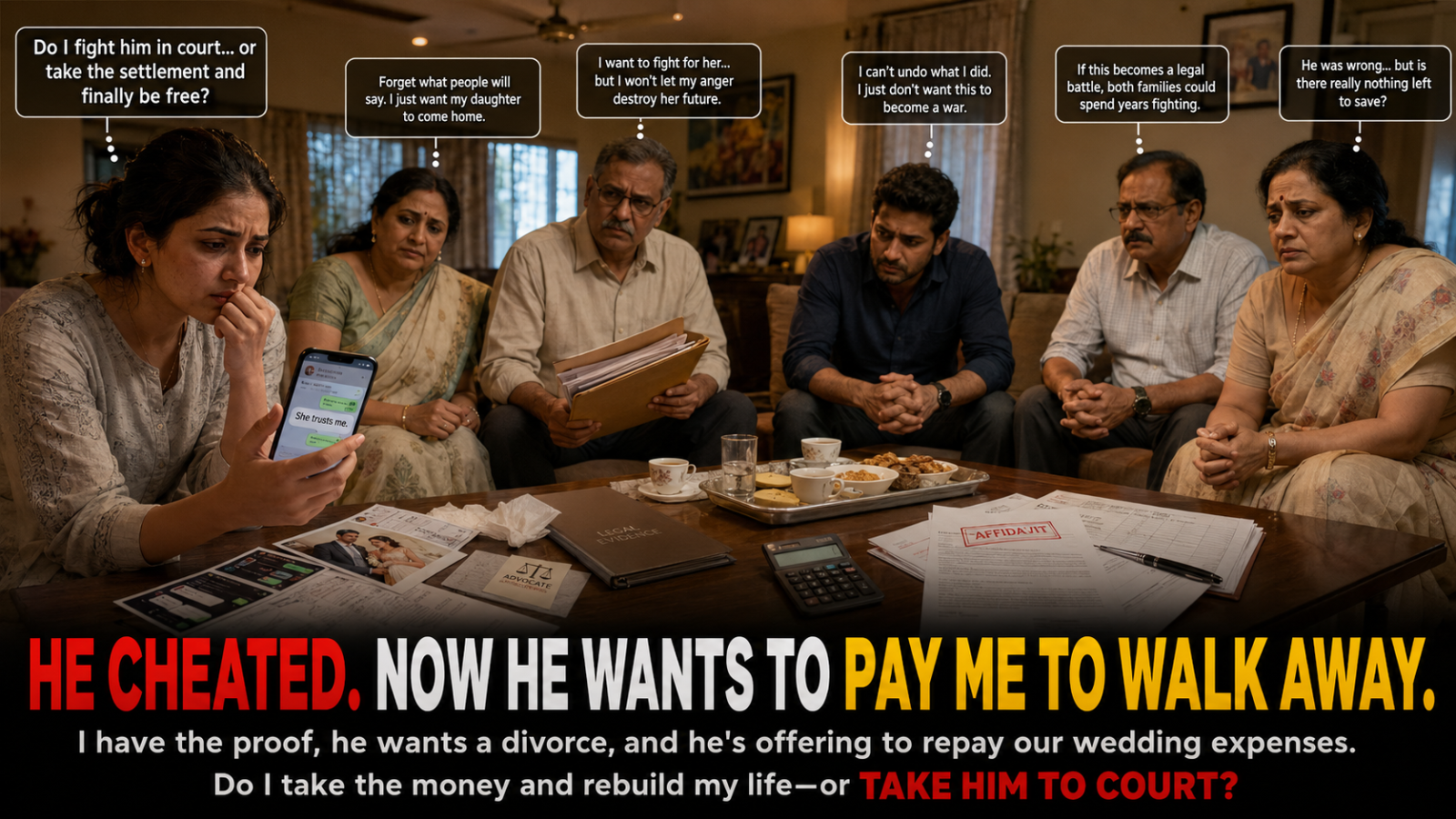
I have proof of my husband’s affair, but after months of trying to save our marriage, the question haunting me is no longer whether he betrayed me. It is whether fighting him in court will give me justice, or simply take more from me than he already has.
The Sentence He Said in Front of Both Families
My husband asked for a divorce while my father was sitting across from him.
There were eight people in the room, but after he said the word, I remember only my father’s hands.
They were resting on his knees.
He had clasped them together so tightly that the skin around his knuckles had turned pale.
On the coffee table between our families were two untouched cups of tea, a plate of biscuits nobody wanted, and a bowl of namkeen my mother had insisted on bringing out because, apparently, some habits survive even when a marriage is being dismantled in front of you.
My husband had been quiet for most of the meeting.
Then he leaned forward slightly and said it.
“I don’t think there is anything left to repair. I want a divorce.”
Nobody responded immediately.
His father looked at the floor.
His mother shifted in her chair.
My mother stared at him as if she had misunderstood the sentence.
I didn’t.
By then, we had spent months trying to repair what his affair had broken.
Counselling.
Arguments.
Apologies.
Promises.
Checking in with each other.
Trying not to mention the woman whose messages I had once read with my own hands shaking so badly that I had to place his phone on the bed.
We had done what people tell married couples to do.
“Give it another chance.”
“Don’t make a decision while you’re angry.”
“Think about your future.”
“Every marriage goes through difficult phases.”
I had listened.
I had stayed.
And sitting there between two families who had once gathered for wedding photographs and rituals, I finally understood something I had been refusing to accept.
Trying was not the same thing as healing.
Sometimes two people can genuinely try and still fail.
What happened after that meeting is the reason I am writing this confession now.
Because my husband did not simply ask for a divorce.
Later, when the two of us spoke privately, he made me an offer.
He said he was willing to return as much as reasonably possible of the money my father had spent on our wedding. He said he would reimburse household expenses my family and I had borne during the marriage. He was even willing to sign a stamped affidavit making the financial arrangement formal.
On paper, it sounded almost civil.
Almost responsible.
Maybe even generous, depending on who tells the story.
But I have proof that he cheated.
I have lived through months of humiliation, anxiety and emotional exhaustion.
And now I am forced to decide whether I want a settlement…
or a fight.
The strange thing is that I no longer know which one would make me feel less defeated.
Also read: Struggles of a Lonely Wife: A Story of Love, Betrayal, and Desperation
Before I Found the Proof, I Was Already Explaining Him to Myself
There was no single dramatic warning sign.
That is one thing I wish people understood about betrayal.
Sometimes the person does not suddenly become a stranger.
Sometimes they remain almost exactly the same.
They still ask whether you want tea.
They still complain about traffic.
They still remind you that the electricity bill is due.
They still lie beside you at night.
They simply create another version of their life somewhere you cannot see.
My husband became more protective of his phone before I became suspicious enough to admit I was suspicious.
He had always used a password. That wasn’t unusual.
What changed was the way the phone began following him.
Bathroom.
Balcony.
Kitchen.
Even if he went to fill a bottle of water, it went with him.
I noticed.
Then I corrected myself.
He works. People message him.
I told myself I was becoming insecure.
Marriage makes you confront uncomfortable parts of yourself. I knew I could become anxious. I knew I sometimes overthought things.
So every time something seemed strange, I found a reasonable explanation for it before I allowed myself an unreasonable one.
He was tired.
He was stressed.
His workload had increased.
He needed space.
Maybe I had become too demanding.
Maybe married life had settled into routine and I was mistaking normal distance for something darker.
Once, during dinner, his phone lit up beside his plate.
I saw only a notification preview and a woman’s name.
He turned the phone face down almost immediately.
I looked at him.
He kept eating.
“Who’s that?”
He didn’t even look up.
“Office.”
“Office has a name?”
He smiled slightly.
“People in offices usually do.”
Normally, I might have laughed.
That night, I didn’t.
He noticed.
“Don’t start making stories in your head.”
That sentence stayed with me because I had not accused him of anything.
Yet he had already defended himself against an accusation I had not made.
Still, I let it go.
That became a pattern.
I would notice something.
He would explain it.
I would feel embarrassed for noticing.
Then I would apologize internally for distrusting my own husband.
Looking back, I sometimes feel angrier about those months than I do about the actual discovery.
Because before he lied directly to me, I participated in the lie by constantly persuading myself not to believe what I was seeing.
Also read: Marrying Non-Virgin Girls in Arranged Marriages: Genuine Questions and Perspectives
The Proof Wasn’t One Message
People ask what I found.
The answer is complicated because there wasn’t one single photograph or one sentence that contained the entire betrayal.
It was a collection.
Messages.
Deleted conversations that were not deleted properly.
Call records.
Dates that matched evenings he had told me he was somewhere else.
Screenshots.
Language that left very little room for innocent interpretation.
There were conversations intimate enough that I still feel uncomfortable remembering them.
Not because of what they said about her.
Because of what they said about my marriage.
Certain dates were especially difficult.
Days when he had been affectionate with me.
Days when we had gone out together.
Days when I had sat beside him discussing our future while, apparently, another relationship existed in parallel.
The night I found enough evidence that I could no longer explain it away, he was asleep.
I remember the ceiling fan making a faint clicking noise.
I remember the charger cable stretched across the bedside table.
I remember entering a password with fingers that suddenly seemed incapable of pressing the correct numbers.
And I remember the absurd thought I had after reading the first few messages.
I thought: Maybe I’m misunderstanding.
That is what shock actually looked like for me.
Not screaming.
Not throwing his phone.
Not waking him immediately.
Just sitting beside a sleeping man and trying to invent an interpretation in which the obvious thing in front of me meant something else.
I read more.
Then more.
At some point I stopped reading the words individually.
I began looking at dates.
That was worse.
Because dates create a timeline.
And a timeline begins rewriting your memories.
That dinner.
That trip.
That argument.
That night he came home late.
That Sunday when he said he needed to step outside for a work call.
Memory becomes contaminated after betrayal.
You no longer remember only what happened.
You remember what you now know was happening simultaneously.
I eventually woke him.
I did not wake him dramatically.
I touched his shoulder.
Once.
Then again.
“Wake up.”
He opened his eyes and looked at me.
I was holding his phone.
His expression changed before I said anything.
That was the confirmation I did not need but received anyway.
“What is this?”
He sat up.
“Give me the phone.”
“What is this?”
“Just give it to me first.”
I pulled it away.
“No.”
There was a long silence.
Then he rubbed both hands over his face.
“It’s complicated.”
I remember almost laughing.
Not because anything was funny.
Because I suddenly understood why people hate that sentence.
“Which part is complicated?”
He did not answer.
“The messages? The calls? The dates? Which part do I need explained?”
He stared at the bed.
“I made a mistake.”
I said something then that I regret.
Not because it was cruel.
Because it was pathetic.
“Do you still love me?”
Even now, I hate remembering that this was one of my first questions.
Not How could you?
Not How long?
Not Who is she?
My first instinct was to ask whether I was still loved.
That tells me more about the state I was in than anything else.
He looked at me and said yes.
I believed him because I needed to.
Also read: The Consequences of Ignoring Self-Respect in Relationships
Everyone Told Me Not to Decide Immediately
By morning, very little remained private.
My parents knew.
Eventually his parents knew.
A small number of relatives became involved because that is how marriages often work in families like ours. Two people marry, but when something breaks, suddenly twelve people become informal mediators.
Some wanted us to separate immediately.
Others wanted us to wait.
A few advised me with complete certainty despite never having lived inside my marriage.
My mother cried more than I did initially.
My father became quiet.
That frightened me more.
He is normally someone who responds to problems practically.
Forms.
Phone calls.
Lists.
Solutions.
But during those first few days, he barely discussed what should happen next.
One evening, he asked me whether I wanted to come home with them.
I said I didn’t know.
“You don’t have to decide everything today.”
I looked at him.
“If I stay, will you think I’m stupid?”
His face changed immediately.
“No.”
“If I leave?”
“No.”
“What if I forgive him?”
He took a few seconds before answering.
“Then forgive him because you want to. Not because you’re afraid of what people will say.”
That sentence became one of the few things anyone said to me during that period that actually helped.
Because people often talk about forgiveness as if it is automatically noble.
Sometimes staying is brave.
Sometimes leaving is brave.
Sometimes forgiving someone restores something valuable.
Sometimes forgiveness becomes permission for another person to hurt you again.
I did not know which situation I was in.
So I stayed.
Not because anyone forced me.
That is important.
I chose to give the marriage another chance.
Also read: Healing from a Toxic Childhood: My Story of Pain, Growth, and Boundaries
The Second Chance Was Harder Than the Betrayal
For a while, he tried.
I want to be fair about that.
He became more transparent with his phone.
He answered questions.
He reduced contact with people or situations that made me uncomfortable.
We tried to spend time together deliberately instead of simply occupying the same house.
There were conversations that felt sincere.
There were apologies that I believe, even now, he meant when he said them.
One night, after weeks of constant tension, he said quietly:
“I know saying sorry doesn’t fix it.”
I did not respond.
“I don’t know what else I can do.”
I looked at him.
“You could tell me why.”
He sighed.
“I’ve told you.”
“You’ve told me what happened. That isn’t the same thing.”
That became our problem.
He wanted a path forward.
I wanted a map backward.
I wanted to understand where our marriage had divided into two realities without my noticing.
He wanted to acknowledge what happened and then gradually stop discussing it.
I could not.
Every ordinary inconsistency became evidence.
If he came home thirty minutes later than expected, I noticed.
If he turned his phone screen downward, I noticed.
If he was unusually quiet after receiving a message, I noticed.
I hated becoming that version of myself.
I did not want to police another adult.
I did not want passwords.
I did not want location updates.
I did not want explanations for every hour.
I wanted the thing that existed before proof became necessary.
Trust.
And there is something humiliating about realizing that even if someone gives you complete access to their phone, you still cannot verify another human being entirely.
There is always another device.
Another account.
Another explanation.
Another possibility.
Trust cannot be replaced by surveillance.
I learned that slowly.
He also began changing.
At first he answered my questions patiently.
Then defensively.
Then with exhaustion.
Eventually, one evening, he said:
“How long am I supposed to keep proving the same thing?”
I stared at him.
“You mean proving you’re not cheating again?”
“That’s not what I meant.”
“Then what did you mean?”
He stood up from the sofa.
“I mean I cannot live forever inside what I did.”
I remember thinking that neither could I.
The difference was that he had created it.
Also read: A Silent Love That Never Faded: My Untold High School Crush Story
We Were Both Trying, but We Were No Longer Trying for the Same Thing
Months passed.
From outside, our marriage probably looked calmer.
The explosive arguments reduced.
There were fewer confrontations.
We attended family occasions.
We discussed practical things normally.
Sometimes we even laughed.
That confused me.
Because people imagine failing marriages as permanently hostile spaces.
Ours was not.
There were evenings when we ordered food and watched something together.
There were mornings when he remembered exactly how I liked my tea.
There were brief moments when I thought perhaps the worst was behind us.
Then something insignificant would trigger everything again.
A notification.
A delayed reply.
A certain place.
A date on the calendar.
Once, we drove past a restaurant and he casually mentioned having eaten there before.
My entire body went tense.
I knew from the dates in the messages that he had been there during the affair.
He realized what he had said.
Neither of us spoke for several minutes.
That was what our second chance became.
Not constant fighting.
Landmines.
Most days looked normal until one of us stepped somewhere dangerous.
Eventually, he stopped believing I would ever trust him again.
Eventually, I stopped believing he understood why I couldn’t.
Neither belief was entirely fair.
Both were probably partly true.
One Sunday, he said:
“Maybe staying together because we’re afraid to end it is worse than ending it.”
I became angry immediately.
“You cheated, and now you’re the one deciding the marriage is too difficult?”
He looked tired.
“I knew you would say that.”
“Because it’s true.”
“I’m not saying what I did was okay.”
“You keep saying that before saying something that somehow makes me responsible for what happened afterward.”
He was silent.
Then he said:
“I don’t think we’re happy.”
That sentence hurt more than I expected.
Because it was true.
Also read: A Journey of Friendship, Love, and Heartbreak
When Our Families Met, Nobody Was Fighting About the Affair Anymore
By the time our families met recently, the issue was no longer whether he had cheated.
That was established.
I had evidence.
He had admitted enough.
The debate had moved to what happens when a marriage survives the discovery but not the consequences.
My parents arrived early.
His family came later.
There were polite greetings.
Nobody knew exactly how formal to be.
My mother offered tea.
His mother said she would take only half a cup.
I nearly laughed because it was such an ordinary conversation occurring before something so final.
For the first part of the meeting, everyone spoke carefully.
My father asked whether counselling could continue.
His father talked about giving things more time.
My husband listened.
Then he said:
“We have already given it time.”
My mother responded immediately.
“Time is not the same for the person who made the mistake and the person who suffered it.”
He nodded.
“I understand.”
My mother looked at him.
“Do you?”
I interrupted because I knew the conversation would go somewhere useless.
“Please. Let him speak.”
He took a breath.
“I don’t think this marriage is healthy for either of us anymore.”
His father turned toward him.
“You’re saying this finally?”
My husband nodded.
“Yes.”
Then came the sentence.
“I want a divorce.”
I had suspected he might say it.
Still, hearing him say it in front of everyone created a strange physical reaction.
Not devastation exactly.
More like embarrassment mixed with relief.
He had finally spoken aloud what our daily life had already been saying.
What He Offered Me Privately
After the family discussion became too crowded with opinions, he asked whether we could speak separately.
We went into another room.
The door remained slightly open.
Neither of us sat at first.
Then I sat on the edge of the bed and he pulled a chair forward.
For several seconds we said nothing.
Finally I asked:
“So this is definite?”
“I think it has to be.”
“You think?”
“I don’t want to keep hurting you.”
I looked at him.
“You know that sentence sounds ridiculous coming from you now.”
He nodded.
“Probably.”
That answer disarmed me more than an argument would have.
Then he started talking about money.
My father had spent heavily on our wedding.
I do not want to give exact figures here, but it was not a small expense for my family.
There had also been household expenses after marriage that I or my family had contributed toward.
My husband said he wanted to return the maximum amount reasonably possible.
“I don’t want this to become another fight between the families.”
I asked what exactly he meant.
He explained that we could calculate the wedding expenditure, other contributions and mutually agreed expenses.
Then he said something I had not expected.
“I’m willing to put it in writing.”
“Writing how?”
“A proper stamped affidavit. Whatever needs to be done legally so you have security that I won’t change my position later.”
I stared at him.
“Why?”
He looked genuinely confused.
“What do you mean, why?”
“Why are you agreeing so easily?”
He leaned back.
“Because I know your father spent money. I know what happened. I’m not saying you should walk away with nothing.”
I hated the phrase walk away with nothing.
Because immediately the conversation sounded transactional.
As though years of trust, humiliation, anxiety and failed reconciliation could be converted into a number.
I said:
“Do you think money settles what you did?”
His answer was immediate.
“No.”
“Then what exactly is it settling?”
He looked at me for several seconds.
“The divorce.”
That was probably the clearest thing either of us had said in months.
The Part Nobody Can Price
I want to make something clear because I know exactly how conversations like this can sound.
I am not trying to become rich from a failed marriage.
I am not looking for easy money.
I did not spend my marriage creating financial demands.
I did not marry him with an exit calculation sitting in the back of my mind.
I wanted the marriage.
That is why I stayed after finding the affair.
That is why this decision has become so complicated.
If I wanted only revenge, perhaps the answer would be easier.
I have proof.
I could speak to a lawyer and explore whatever legal remedies may actually be available to me based on the facts and applicable law.
I could refuse a private settlement.
I could force the entire history into formal proceedings.
Messages.
Dates.
Financial records.
Family statements.
Everything.
Part of me wants that.
Not because I enjoy conflict.
Because accepting money and signing papers feels dangerously similar to allowing the story to end too neatly for him.
He cheats.
I suffer.
He decides the marriage cannot recover.
He repays some expenses.
We sign documents.
He gets to continue his life.
Where exactly, in that sequence, is accountability?
But another part of me sees what a legal war might actually mean.
Months.
Possibly years.
Meetings with lawyers.
Court dates.
Documents.
Repeated retelling.
Money spent proving what I already know happened.
Our families dragged deeper into it.
Every message examined.
Every mistake argued over.
Every private failure converted into evidence.
And I know him.
If the process becomes hostile, I do not believe he will simply surrender.
He will protect himself.
His family will protect themselves.
My family will respond.
Something that is currently painful could become poisonous.
That is what frightens me.
Not losing a case.
Losing another two or three years of my life to winning one.
My Father Asked Me a Question I Still Can’t Answer
Later that night, after his family had left, my father and I sat in the living room.
My mother had gone to bed, although I knew she was awake.
The tea cups from earlier were still in the kitchen sink.
My father asked me whether I thought the financial offer was fair.
I told him I didn’t know.
He nodded.
Then he asked:
“What do you actually want from him?”
I had answers ready.
Justice.
Compensation.
Accountability.
An apology.
Consequences.
But none of those answered his question.
So I said:
“I want him to understand what this did to me.”
My father was silent for a while.
Then he said:
“And if he never understands?”
I looked away.
That question has followed me since.
What if the thing I want most is the one thing no legal process can force another person to give me?
A court can decide rights.
A settlement can determine money.
Documents can create obligations.
But can any of those make another human being understand the private cost of what they did?
I don’t know.
Maybe accountability and understanding are different things.
Maybe I have been treating them as the same.
He Doesn’t Look Like a Villain Anymore, and Somehow That Makes It Harder
There was a period when I hated him.
That period was simple.
Anger gives everything a clear shape.
He betrayed me.
I was hurt.
He was wrong.
I was right.
Then time complicated it.
I began remembering that the person who cheated on me was also the person I had once chosen.
The same person who had taken care of me when I was sick.
The same person who knew which foods I refused to eat.
The same person who could make me laugh during completely inappropriate situations.
None of that excuses what he did.
But it prevents me from reducing our marriage to one sentence.
He is not innocent.
I am also no longer interested in building my future around proving that he is evil.
Those are not the same thing.
When we spoke again a few days after the family meeting, I asked him whether he was offering the settlement because he felt guilty.
He thought about it.
“Partly.”
“What’s the other part?”
“I want this to end without destroying everyone.”
I said nothing.
Then he added:
“Especially you.”
I almost became angry again.
Instead I asked:
“Do you really believe you get to protect me now?”
He looked down.
“No.”
For once, he did not explain himself.
The Decision in Front of Me
So this is where my confession actually ends.
Not with the discovery.
Not with the affair.
Not even with the divorce request.
It ends with paperwork I have not yet signed.
I am deciding between two imperfect forms of closure.
One option is to negotiate carefully, make sure any financial arrangement is legally sound, protect my interests, take what I am reasonably entitled to, and leave.
No prolonged war.
No years organised around him.
No waking up on hearing dates because my entire life has become a legal file.
The other option is to fight.
To pursue whatever remedies the law genuinely allows based on the circumstances.
To refuse to make his exit comfortable merely because he is now offering money.
To insist that betrayal, emotional harm and the consequences of his actions are not simply erased because he wants an orderly divorce.
Some days I think accepting a settlement would mean choosing myself.
Other days it feels like surrender.
Some days I imagine walking out of a lawyer’s office after everything is signed and feeling lighter than I have felt in years.
Other days I imagine him feeling relieved that everything was resolved financially and wonder whether I would spend the rest of my life resenting myself for making it so easy.
Then I catch myself using that word.
Easy.
There has been nothing easy about this.
I Am Starting to Understand That Moving On Is Also a Decision About Cost
For months, I measured cost only in money.
What my father spent.
What I spent.
What he is offering.
What lawyers might charge.
What years of litigation might consume.
Now I am beginning to see that there are other currencies.
Sleep.
Concentration.
Family peace.
Time.
The ability to enter another relationship without carrying this one into it.
The number of mornings I want to wake up thinking about my husband after he is no longer my husband.
I do not yet know how much justice is worth.
I do know that revenge can become expensive even when you can afford it.
And peace can sometimes feel unfair before it begins to feel peaceful.
That is why I am hesitant to listen to people who tell me automatically to “fight him” or automatically to “take the money and move on.”
They will not attend the hearings.
They will not sit across from him during negotiations.
They will not watch my parents age while this remains the central problem in our house.
They will not live with whichever decision I make.
I will.
What lies ahead for me
A few nights ago, I found one of our wedding photographs while looking for something else.
It had slipped behind a folder.
In the picture, my father is standing beside us smiling.
My husband is looking at the camera.
I am looking slightly toward him instead.
I stared at that photograph for several minutes.
There was a time when I believed the worst possible ending to my marriage would be discovering that my husband had cheated.
I was wrong.
The harder ending is discovering that after the betrayal, after the apologies, after the second chance and after both families become involved, there may still be no satisfying punishment, no perfect settlement and no decision that restores the person I was before I found those messages.
There is only a choice about what I protect now.
My money.
My dignity.
My sense of justice.
My family.
My remaining time.
My peace.
Maybe I can protect all of them.
Maybe I cannot.
The affidavit is still unsigned.
The evidence is still with me.
And for the first time since I discovered his affair, I am trying to make a decision based not on what will hurt him most, but on what will leave the smallest permanent mark on me.
Follow Us On Social Media:
[husband cheated, cheating husband, divorce after infidelity, marriage betrayal, adultery confession, divorce settlement, relationship confession, emotional betrayal, marriage problems, family pressure, rebuilding trust, contested divorce, infidelity recovery, The Confessions, Confession Stories]


Well explained and practical. I’ve had good results with WanVideoGen () for short cinematic clips.. WanVideoGen
Well explained and practical. I’ve had good results with Gem Transcribe () for meeting and podcast transcripts.. Gem Transcribe