The Confessions shares a raw look into a Kerala husband’s financial struggles as his wife secretly hoards wealth for children they do not have.
The Confessions: Trapped in a Slow, Deliberate Real Estate Marriage Trap
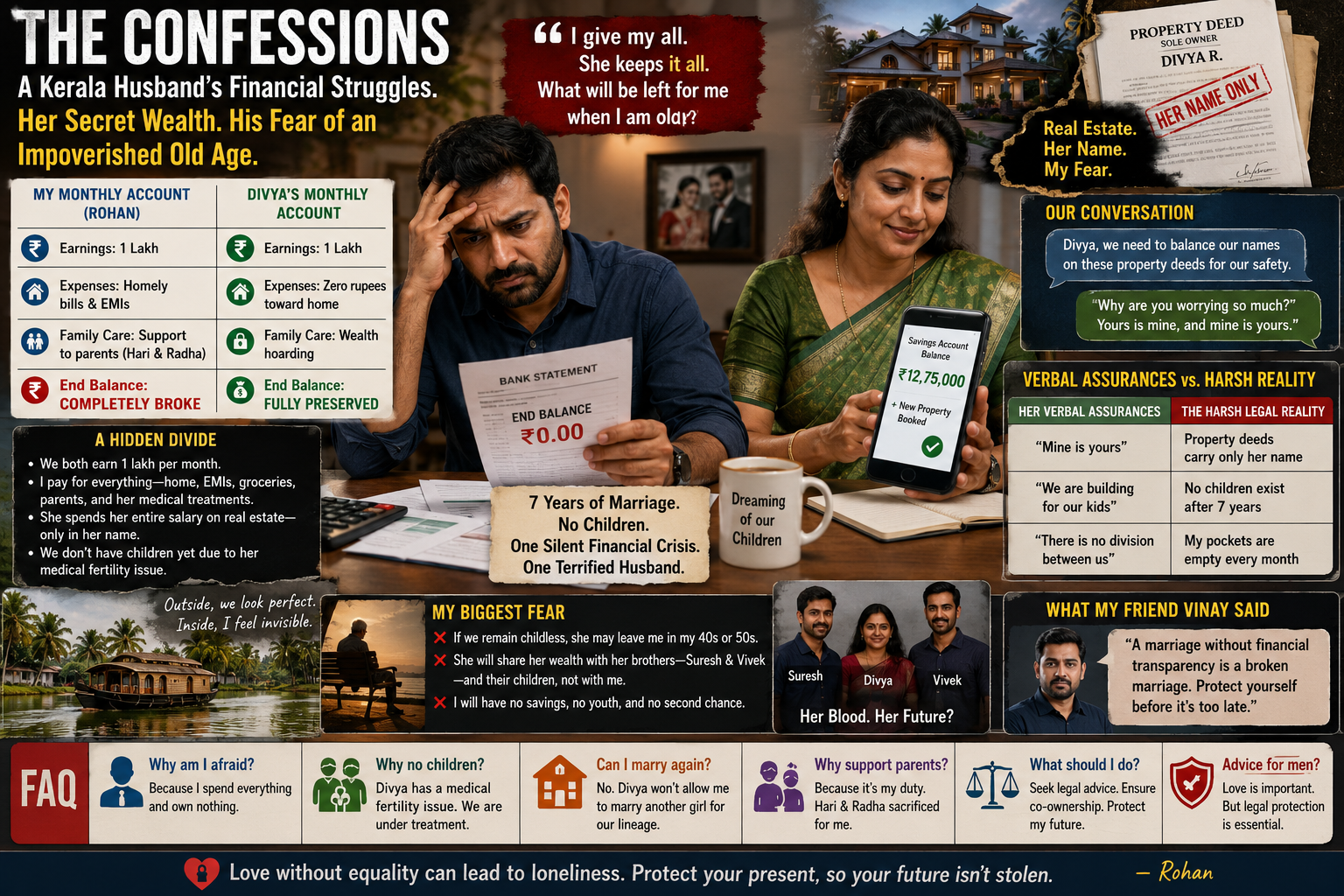
I stare blankly at my empty bank account statement at the end of every single month, but The Confessions I must make today have far less to do with budgeting and much more to do with absolute panic about my long-term survival. My wife, Divya, sits across the table from me checking her own booming savings account, completely oblivious to the cold fear gripping my chest. We have been bound together in an arranged marriage for seven long years here in Kerala, yet I feel entirely isolated in my own home. A suffocating emotional conflict grows inside me because our financial division feels less like a partnership and more like a slow, deliberate trap. I am terrified that my unconditional love and financial compliance are quietly setting me up for total ruin and desertion when I am too old to rebuild my life.
A Hidden Divide in an Arranged Kerala Marriage
Our story began seven years ago when our families arranged our marriage with the highest hopes for our mutual stability and happiness. Today, I am a 39-year-old corporate professional, and Divya is a 38-year-old school administrator with a highly predictable routine. On paper, our partnership looks completely ideal to the outside world because each of us earns a very comfortable salary of around 1 lakh monthly. This combined income should easily place us among the upper-middle class, allowing us to build an impressive financial safety net together.
Unfortunately, the reality inside our household is completely different from what our friends and neighbors see. Divya does not spend a single penny from her salary on our shared household expenses or groceries. Meanwhile, I am almost completely out of pocket at the end of every single month due to a heavy combination of bank EMIs, daily homely expenditures, and a little essential monthly financial support to my aging parents, Hari and Radha. To make matters even more frustrating, Divya frequently asks me for extra money to cover her own very small personal expenses. I rarely mind helping her with these small sums, but the mounting imbalance has quietly begun to breed deep resentment within my heart.
Divya uses the substantial money she systematically collects from her salary to buy prime real estate properties entirely in her own name. Whenever I gently bring up this unequal distribution of wealth, she quickly defends her actions with a reassuring smile. She claims she is collecting all this real estate property solely for the future security of our children. However, the painful truth is that we do not have any children yet due to a complex medical issue she is currently facing. I love her deeply, so I am happily bearing the massive costs of her ongoing medical treatments without a single complaint. This ongoing childless reality forces me to face a painful realization about the true security of my financial future.
The Childless Crisis and Fear of Aging Alone
As the months pass by without any positive news from the fertility clinic, my inner panic continues to grow exponentially. I am getting incredibly worried about my future well-being and what will happen to me when my working years are permanently over. If we, despite all our emotional and medical efforts, do not get a child in the next few years, I will be left completely vulnerable. Divya is absolutely not ready for me to marry another girl to continue my family lineage, yet she stubbornly holds all our accumulated wealth and property exclusively in her own name.
The Confessions of a Vulnerable Husband
I lie awake at night imagining the most terrifying scenario for my upcoming fifties, and the psychological trauma is completely paralyzing. I fear she may quit our relationship and abandon me in my late 40s or 50s. History shows that a childless woman will almost certainly prefer to share her hard-earned property with her own blood relatives, such as her brothers, Suresh and Vivek, and her nephews, rather than with the family of her husband.
“Divya, we need to balance our names on these property deeds for our safety,” I told her quietly during a rainy evening conversation.
“Why are you worrying so much?” Divya replied smoothly, waving her hand defensively. “There is absolutely nothing divided between us. Yours is mine, and mine is yours.”
Her comforting words sound beautiful, but they offer absolutely no legal protection against the harsh financial realities of old age. In that disastrous scenario, I would hardly be having any wealth or savings of my own, nor would I possess the youth or age to settle down and start over again. Once I openly expressed this terrifying fear to my best friend, Vinay, he told me that a marriage without shared financial transparency is fundamentally broken. I am left standing at a dangerous crossroads, forced to decide whether our family cart is being driven well, or if I desperately need to be cautious of massive, destructive upcoming jerks in my old age.
FAQ Section
What is the primary financial conflict in The Confessions story shared above?
The primary conflict involves a husband in Kerala who spends his entire 1 lakh monthly salary on home expenses, EMIs, and elderly parents, while his wife hoards her equal salary to purchase real estate properties exclusively in her own name.
Why is the wife hoarding property under her own name?
Divya claims she is accumulating these properties to secure the future of their children. However, the couple currently has no children after seven years of marriage, making the husband deeply anxious about where that wealth will eventually go.
What medical issue is affecting this Kerala marriage?
The marriage is experiencing a silent crisis due to a chronic medical fertility issue that Divya is facing. Her husband, Rohan, is happily bearing the entire financial burden of her medical treatments, even though it leaves him entirely out of pocket.
Who are Suresh and Vivek in this family relationship struggle?
Suresh and Vivek are Divya’s brothers. Rohan terrifically fears that if they remain childless, Divya will eventually leave him in his old age and pass all her real estate wealth to her brothers and nephews rather than sharing it with him.
How does the wife respond to the husband’s financial fears?
When Rohan expresses his deep vulnerability and fear of an impoverished old age, Divya dismisses his concerns with verbal reassurances, stating that everything they own is shared equally, despite the legal deeds saying otherwise.
What cultural factors influence the husband’s anxiety about remarriage?
In traditional setups, continuing the family lineage is highly emphasized. However, Divya refuses to allow Rohan to marry another girl to have children, while simultaneously keeping all financial assets out of his legal reach.
Is the husband able to save any money for his own future?
No, Rohan is completely unable to save money because his entire monthly income is exhausted by household expenditures, bank loans, supporting his parents, Hari and Radha, and paying for expensive fertility treatments.
What long-tail advice applies to men facing unequal marital financial structures?
Financial experts suggest that relationships require absolute transparency. Legal co-ownership of assets bought during a marriage is essential to protect both partners from loneliness, rejection, and complete financial abandonment in their later years.
Related Articles
- Why My Secret Love is Burning My Life Down
- The Entity Wearing My Mother’s Face
- Why My Broken Trust Ruined Everything
- I Buried My Childhood Before My Dreams Part – 1
- I Buried My Childhood Before My Dreams Part – 2
- I Forgot the Woman I Used to Be
- Nawanshahr Murder Investigation Expands
- UP Child Murder Case Takes New Turn
- Dehradun Woman’s 10-Month Ordeal
- Bengaluru Man Extorts Girlfriend Using Private Videos: A Shocking Tale of Betrayal
- Masturbation Habit and Family Crisis: A Father’s Dilemma
Explore more Confession Stories here
Follow Us On Social Media:
[Fantasy confession latest, fantasy confession stories latest, fantasy confessions latest, #confessionstories latest, real fantasy confession latest, confessions fantasy latest, confession fantasy latest, fantasy confession latest 2026, fantacy confession latest, real confession stories latest, confession of fantasy latest, confession fantasies latest, fantasy confessions hindi latest, story confessions latest, adult confessions]