

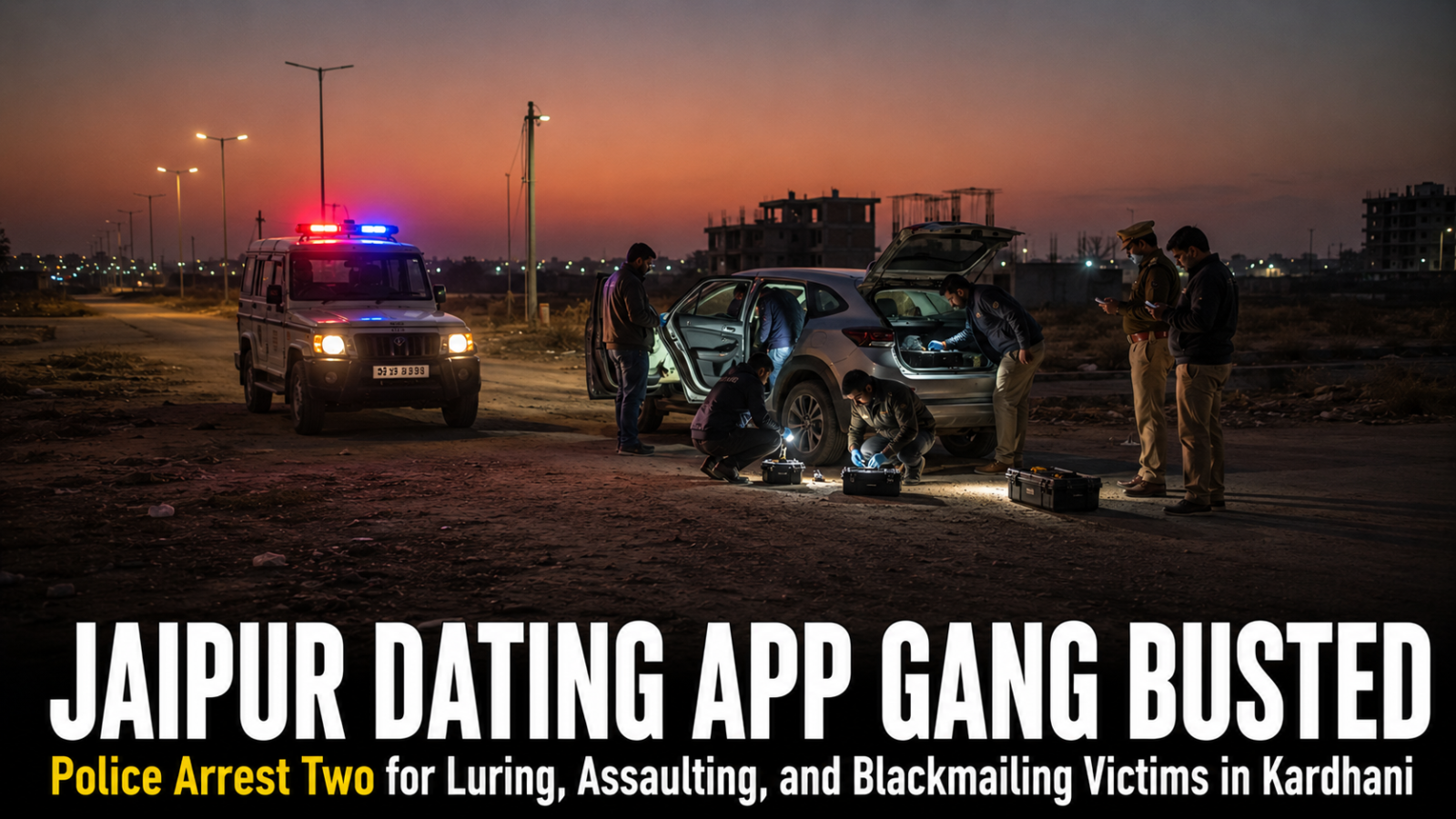
In a major crackdown against digital honeytrapping and violent extortion, the Kardhani Police Station under the Jaipur West Police District has dismantled an organized criminal syndicate targeting men through gay dating applications. Operating under the guise of romantic encounters, the gang lured unsuspecting individuals to secluded locations, subjected them to brutal assaults, and extorted large sums of money by exploiting the fear of social stigma.
Executive Overview of the Operation
- Jurisdiction and Action: Kardhani Police Station, Jaipur West District, Rajasthan Police.
- Key Suspects Arrested: Anil Rulaniya and Madan Nehra.
- Seized Assets: An SUV/car used to transport gang members and intercept victims, alongside digital smartphones containing dating app logs and communication transcripts.
- Modus Operandi: Creating attractive profiles on gay dating platforms (such as Grindr and related apps), initiating casual conversations, scheduling physical meetings in isolated outskirts of Jaipur, ambushing victims, physical assault, video recording for blackmail, and forced financial transfers.
- Investigative Scope: Interrogation is actively underway to determine the total number of victims, map interstate links, and identify accomplices who assisted in money laundering and physical ambushes.
Detailed Investigation: The Kardhani Police Crackdown
Over recent weeks, the Jaipur Police Commissionerate received discreet intelligence inputs and informal complaints suggesting that an organized gang was actively hunting users on same-sex dating applications. Victims reported being lured to remote suburban sectors of Jaipur under the premise of personal meetings, only to find themselves cornered by multiple assailants who assaulted them, robbed their personal belongings, and threatened them with public exposure.
Taking cognizance of the emerging pattern, senior officers in the Jaipur West District directed the formation of a dedicated investigation team at the Kardhani Police Station. The operational unit deployed digital forensics, call detail record (CDR) tracking, and cyber surveillance to trace the digital footprint of the suspicious dating profiles.
The breakthrough occurred when cyber investigators identified a recurring pattern of mobile numbers and IP addresses active near isolated stretches in the Kardhani area. Armed with technical evidence, police intercepted and arrested two prime operatives: Anil Rulaniya and Madan Nehra. Officers also confiscated the four-wheeler used by the accused to stage ambushes and rapidly flee crime scenes.
During preliminary custodial interrogation, the accused revealed that they had systematically targeted multiple individuals across Jaipur. Police are currently examining the digital contents of the seized mobile phones to uncover chat logs, financial transaction records via Unified Payments Interface (UPI), and private videos recorded to coerce victims.
Also read: Read Latest News Online: Jaipur Daughter Hires Killers to Murder Mother
Modus Operandi: Anatomy of the Dating App Trap
The investigation into Anil Rulaniya and Madan Nehra exposed a calculated and predatory operational blueprint designed to exploit emotional trust and social vulnerability. The syndicate executed their crimes through a multi-stage process:
Stage 1: Digital Profiling and Grooming
The gang created falsified, appealing user profiles on popular LGBTQ+ dating platforms. They engaged users in friendly, casual conversations to gauge their background, socioeconomic status, and willingness to meet in person. The suspects maintained a polite and reassuring digital persona over several days or weeks to establish rapport and lower the victim’s guard.
Stage 2: Location Selection and the Secluded Meetup
Once mutual trust was established, the perpetrators proposed an offline rendezvous. Under the pretext of seeking privacy, they intentionally steered victims toward isolated, poorly lit, or desolate stretches on the outskirts of Jaipur, such as empty plots, semi-developed residential sectors, or rural bypass roads around the Kardhani and Kalwar zones.
Stage 3: Physical Ambush and Violent Intimidation
When the victim arrived at the agreed location, the dynamics shifted instantaneously. Instead of a one-on-one meeting, the victim was suddenly confronted by multiple gang members. The perpetrators used intimidation, verbal abuse, and immediate physical violence to disorient and overpower the individual.
Stage 4: Extortion, Digital Robbery, and Video Blackmail
With the victim subdued, the gang seized smartphones, wallets, jewelry, and vehicle keys. They forced victims to unlock their mobile banking and UPI applications at knifepoint or under threat of severe beating, transferring available balances to third-party mule accounts. Furthermore, the perpetrators frequently forced victims to strip or staged compromising poses to record explicit videos on their phones.
Stage 5: Weaponizing Stigma and Enforcing Silence
Before releasing the victim, the gang delivered explicit threats: if the victim approached the police or disclosed the incident to anyone, the compromising footage and personal identity details would be broadcast to their family members, workplace colleagues, and across social media. Relying on the deep social stigma associated with alternative sexual orientations in traditional family structures, the syndicate counted on the victim remaining silent.
Why Dating App Blackmail Gangs Target the LGBTQ+ Community
The rise of targeted cyber-extortion gangs preying on same-sex dating platforms is not an isolated phenomenon in Jaipur; it represents a broader trend across metropolitan and tier-2 Indian cities. Several systemic factors make queer men particularly susceptible to these predatory networks:
1. The Fear of Being Outed
Despite the landmark decriminalization of Section 377 by the Supreme Court of India in 2018, widespread social prejudice, familial pressure, and fear of ostracization persist. Many individuals maintain discreet personal lives. Extortionists leverage this confidentiality as their primary weapon, knowing that the fear of involuntary disclosure often outweighs the financial loss.
2. Reluctance to Approach Law Enforcement
Historically, victims of dating scams from the LGBTQ+ community have hesitated to file formal police reports due to concerns about insensitivity, invasive questioning, or leaks that could expose their identity to relatives. Criminal networks actively exploit this perceived reporting barrier, operating under the assumption that their crimes will go completely unpunished.
3. Rapid Proliferation of Geolocation-Based Apps
Mobile dating applications rely on precise GPS location tracking to connect individuals in close physical proximity. While this feature simplifies networking, it also allows malicious actors to pinpoint potential targets in real-time, assess their movements, and set traps within specific suburban radiuses.
Chronological Breakdown of the Jaipur Kardhani Operation
- Step 1 – Initial Intelligence Gathering: Jaipur West Police detect anonymous patterns of online harassment, sudden bank balance drains, and distress queries connected to dating app meetups in the Kardhani area.
- Step 2 – Technical Cell Surveillance: The cyber crime cell analyzes IP logs, suspicious mobile numbers, and bank account footprints linked to rapid UPI cashouts.
- Step 3 – Field Reconnaissance: Undercover police teams track suspect movements around identified isolated rendezvous points in the suburban outskirts.
- Step 4 – Interception and Apprehension: Police successfully intercept the four-wheeler used by the perpetrators, arresting Anil Rulaniya and Madan Nehra on the spot.
- Step 5 – Evidence Collection: Seizure of mobile devices, verification of digital chats, and cataloging of financial transactions to build an airtight evidentiary trail.
- Step 6 – Interrogation and Network Mapping: Custodial interrogation initiated to uncover additional accomplices, locate hidden digital files, and encourage past victims to provide confidential witness statements.
Legal Provisions and Statutory Framework
The accused in the Jaipur dating app racket face severe prosecution under the Bharatiya Nyaya Sanhita (BNS) and the Information Technology Act, 2000. The charges filed and under consideration include:
1. Premeditated Extortion and Robbery
- Section 308 (BNS) – Extortion: Puts a person in fear of injury or reputational ruin in order to dishonestly induce the delivery of property, funds, or valuable securities.
- Section 309 / 311 (BNS) – Robbery and Dacoity with Attempt to Cause Death or Hurt: Covers physical confrontation, armed restraint, and forcible seizure of mobile phones, cash, and vehicles.
2. Physical Assault and Unlawful Confinement
- Section 115 (BNS) – Voluntarily Causing Hurt: Covers physical trauma, beatings, and bodily injury inflicted during the ambush.
- Section 127 (BNS) – Wrongful Confinement: Addresses detaining victims against their will in isolated fields, rooms, or stationary vehicles to demand ransoms.
3. Criminal Intimidation and Conspiracy
- Section 351 (BNS) – Criminal Intimidation: Applying threats to cause injury to a person’s reputation, life, or property, particularly through blackmail via digital media.
- Section 61 (BNS) – Criminal Conspiracy: Applies to the organized collaboration between multiple individuals executing a structured illegal enterprise.
4. Cyber and Digital Offences under the IT Act
- Section 66E – Violation of Privacy: Capturing, publishing, or transmitting images of private areas of an individual without consent.
- Section 67 / 67A – Transmission of Obscene Material: Generating and threatening the distribution of sexually explicit content across electronic communications.
Comparative Context: Cyber Honeytraps Across Major Indian Hubs
The Jaipur arrest reflects a broader pattern seen in urban law enforcement across India. Similar syndicates have been dismantled in recent months across Gurugram, Delhi-NCR, Ahmedabad, Mumbai, and Bengaluru.
- The Impersonation Model (Delhi-NCR & Gurugram): Gangs often pose as fake police officers or journalists, staging a mock “raid” at the meeting venue and demanding heavy bribes under the false threat of criminal booking.
- The Violent Ambush Model (Jaipur & Ahmedabad): Perpetrators use brute force in remote outskirts, snatching physical assets and forcing immediate UPI digital wallet clearing.
- The Long-Term Video Blackmail Model (Bengaluru & Pune): Culprits record non-consensual videos and establish an ongoing extortion channel, demanding monthly payments from salaried professionals over extended periods.
In all variations, the underlying mechanism remains consistent: weaponizing privacy, isolation, and social hesitation to prevent reporting.
Technical and Forensic Evidence Gathering in Digital Extortion
For law enforcement to secure convictions in dating app extortion cases, digital forensics plays a decisive role alongside traditional police work. In the Jaipur case, the investigative team is following strict protocols to preserve electronic evidence:
Digital Footprint Recovery
- Device Hash Certification: Creating forensically sound bit-stream images of seized mobile phones to ensure evidence is tamper-proof in accordance with the Bharatiya Sakshya Adhiniyam (BSA).
- Deleted Media Recovery: Utilizing specialized forensic software to retrieve deleted chat histories, temporary media, and video recordings used for blackmail.
- IP and Geolocation Triangulation: Matching dating app login timestamps and cell tower triangulation data with the physical presence of the accused at the crime scene.
Financial Forensics
- UPI Transaction Chains: Tracing money trails from the victim’s account through payment gateways, intermediary bank accounts, and merchant QR codes.
- ATM CCTV Retrieval: Extracting timestamped surveillance footage from ATMs where stolen debit cards were used or cash was withdrawn.
Also read: Agra Man Allegedly Drowns 18-Year-Old Pregnant Daughter in Chambal River
Essential Safety Protocols for Online Dating App Users
To protect personal safety and privacy while navigating online dating applications, cybersecurity experts and law enforcement authorities recommend the following proactive safety measures:
1. Verify Identity Before Meeting Offline
- Conduct Video Calls: Always conduct an in-app or verified video call before scheduling an in-person meeting. Scammers and gang members operating fake profiles almost always refuse video calls.
- Cross-Reference Social Profiles: Look for established digital footprints on other verified platforms (such as LinkedIn, Instagram, or Facebook) to confirm identity.
- Watch for Red Flags: Be alert to profiles with only one picture, vague bios, rushed declarations of interest, or immediate requests to meet in secluded spots.
2. Choose Public, Well-Lit, and Familiar Meeting Venues
- Never Agree to Isolated Spots: Refuse invitations to meet in unpopulated parks, unfamiliar apartments, desolate outskirts, or quiet rural roads.
- Select Populated Venues: Opt for bustling public places such as popular cafes, metro station concourses, shopping malls, or busy restaurants during daytime hours.
- Maintain Independent Transportation: Always arrive and depart using your own vehicle, public transport, or verified ride-hailing services. Never accept rides from an unfamiliar acquaintance to an unverified location.
3. Share Live Location with a Trusted Contact
- Emergency Check-Ins: Inform a close friend or family member about the meetup details, including the contact’s name, profile details, venue, and expected return time.
- Live Location Sharing: Keep real-time GPS location sharing enabled on WhatsApp or Google Maps with a trusted contact throughout the duration of the meetup.
4. Protect Financial and Personal Data
- Set App Limits: Keep daily digital transaction limits conservative on UPI apps to minimize potential losses in an emergency.
- Never Hand Over Devices: Keep your smartphone secured with biometric locks, and avoid allowing new acquaintances to handle your unlocked phone.
Also read: Jaipur Man Found Dead Dressed in Lehenga and Makeup, Family Initially Mistook Him for a Woman
What to Do If You Are Targeted by an Extortion Racket
If you or someone you know falls victim to a dating app trap or extortion racket, immediate and structured action is critical to limit harm and bring perpetrators to justice:
Step 1: Prioritize Personal Safety and Exit the Situation
Do not attempt to physically engage multiple armed assailants. Comply with demands to preserve your life and physical wellbeing, and leave the location as soon as possible.
Step 2: Preserve All Digital Evidence
- Do Not Delete Chats: Preserve all conversation threads, profiles, phone numbers, and social media handles.
- Take Immediate Screenshots: Capture full-screen screenshots showing timestamps, usernames, phone numbers, and profile photos before the perpetrator deletes the account or blocks you.
- Document Financial Transactions: Save UPI reference IDs, transaction screenshots, recipient bank details, and payment receipts.
Step 3: Report Immediately to the Cyber Crime Helpline
- National Cyber Crime Helpline: Call 1930 immediately to report financial fraud. Reporting within the “golden hour” (the first few hours after an unauthorized transaction) maximizes the chance of banks freezing stolen funds in recipient accounts.
- Official Cyber Crime Portal: Lodge a detailed complaint at
www.cybercrime.gov.in. You can file complaints anonymously or report cyber-extortion directly under confidential categories.
Step 4: Approach the Police with Assurance of Confidentiality
Law enforcement agencies, including Rajasthan Police, treat extortion and blackmail cases with strict confidentiality. When filing a First Information Report (FIR), victims can request that sensitive personal details and sexual orientation remain protected from public court documents and media leaks.
Platform Responsibility: The Need for Stricter Verification Mechanisms
The recurring misuse of dating platforms for organized crime has intensified calls for dating app companies to implement stricter security standards:
- Mandatory Profile Verification: Platforms must introduce mandatory selfie verification and multi-factor authentication (MFA) to curb the creation of disposable, anonymous fake profiles.
- AI-Driven Anomaly Detection: Dating algorithms should automatically flag suspicious messaging patterns, such as accounts that send identical meetup locations in isolated zones to dozens of users simultaneously.
- Integrated Emergency Alerts: Applications should incorporate an easily accessible in-app SOS button that instantly shares live location data with emergency contacts and local law enforcement.
- Proactive Warning Banners: Apps should display clear contextual warnings when users plan meetups, reminding them to avoid isolated locations and verify their contact’s identity.
Frequently Asked Questions (FAQ)
What happened in the Jaipur gay dating app extortion case?
The Kardhani Police in Jaipur West arrested two individuals, Anil Rulaniya and Madan Nehra, who created fake profiles on gay dating platforms, lured men to isolated locations, violently assaulted them, and extorted money through robbery and video blackmail.
Which police station handled the arrests in Jaipur?
The operation was planned and executed by the Kardhani Police Station under the Jaipur West Police District.
What was the primary weapon used by the gang to silence victims?
The syndicate weaponized social stigma and the fear of being outed by recording non-consensual compromising videos and threatening to send them to the victim’s family, friends, and employers if they reported the crime.
What items were seized from the arrested suspects?
Police seized mobile phones containing chat records and evidence, along with the vehicle/SUV used by the gang to stage the ambushes.
How can victims of dating app extortion report the crime without risking their privacy?
Victims can call the national cyber helpline at 1930 or submit an online report at cybercrime.gov.in. Law enforcement authorities handle extortion, physical assault, and blackmail complaints with strict confidentiality regarding personal identity and sexual orientation.
Also read: UP Child Murder Case Takes New Turn
Follow Us On Social Media:
[latest news today, world news, latest world news, world latest news, world news latest, latest news world, iran latest news, latest iran news, iran news latest, iran news, latest news iran, world cup latest news, latest ai news, fifa world cup, fifa world cup 2026, war latest news, latest war news, war news latest, india latest news, latest news india, us iran news latest, latest news iran war, iran us latest news, us iran latest news, iran us news latest, iran war news latest, iran war news, trump news latest, iran war latest news, latest iran war news, trump latest, latest trump news, trump latest news, trump news, latest transfer news, latest world news today, latest hindi news, uk latest news, latest uk news, latest news uk, latest football news, latest news on iran, latest news in hindi, us iran war latest news, iran us war latest news, iran latest news today, us iran war news latest, ukraine latest news, latest ukraine news, wikipedia, latest news on us iran war, latest news on iran us war, us iran war latest news, iran us news latest, iran us war latest news, iran us latest news, latest news iran war, us iran news latest, us iran war news latest, us iran latest news, iran war news, iran war latest news, iran war news latest, us and iran latest news, latest news on iran war, iran latest news, latest iran war news, latest iran news, iran news latest, iran war latest news today, latest news on iran, gift nifty live, latest news iran, gift nifty, iran news, latest war news, war latest news, latest news on war, war news latest, iran latest news today, iran israel war latest news, crude oil price, al jazeera latest news, brent crude price, nifty 50, sensex today, trump news latest, latest trump news, trump latest, trump news, trump latest news, man u latest news, trump latest news today, manchester united latest transfer news, man utd latest transfer news, latest trump news today, wikipedia, chelsea latest transfer news, www electronmagazine .com latest news, manchester united latest news]


Good read! Sharing MiniMax H3 Video Generator (/) — handy for 4–15s cinematic clips. MiniMax H3 Video Generator