

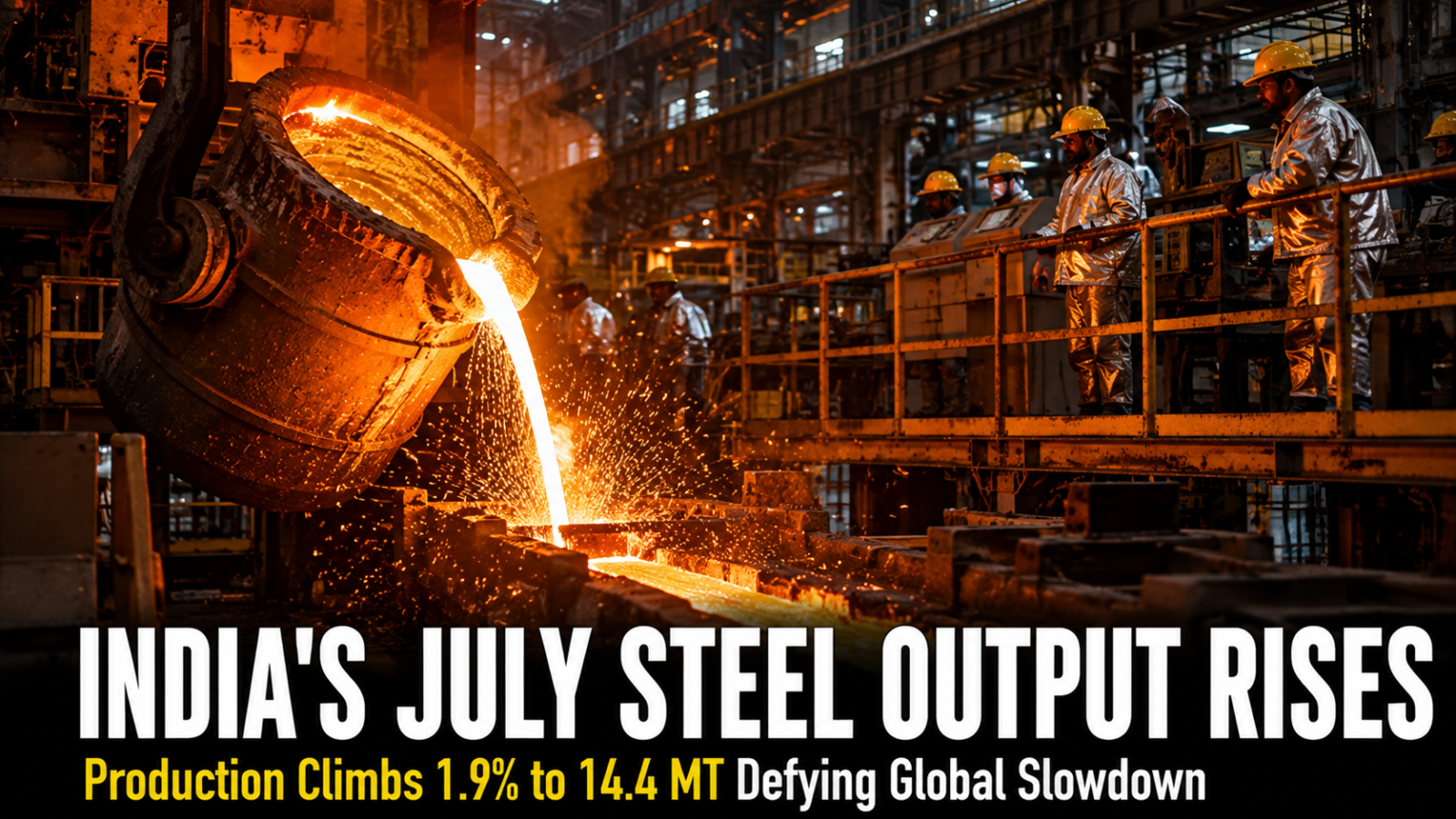
India’s crude steel production advanced by 1.9% year-on-year to 14.4 million tonnes in July 2026, defying a broader international manufacturing slowdown driven by reduced industrial demand and real estate consolidation in China.
Direct Case Overview
- Primary Metric: Global and domestic crude steel production performance for July 2026.
- India Output:Reached 14.4 million tonnes (Mt), recording a 1.9% increase compared to July 2025.
- Cumulative India Output (Jan–Jul 2026):Expanded 6.1% year-on-year to reach 101.1 million tonnes.
- Global Output:Declined 0.3% year-on-year to 149.2 Mt across the 70 reporting member nations.
- China Output:Contracted by 3.6% to 76.9 Mt in July 2026.
- Direct Reduced Iron (DRI): India maintained its status as the world’s largest DRI producer, contributing over 5 million metric tons during the month.
- Primary Source:Monthly data release by the World Steel Association (worldsteel) and tracking by The Hindu BusinessLine.
Detailed Global Steel Production Landscape
The global metallurgical sector experienced divergence throughout July 2026. According to official data compiled by the World Steel Association, total crude steel production across the 70 countries reporting to the organization stood at 149.2 million tonnes.This represented a slight contraction of 0.3% compared to the 150.1 million tonnes produced in July 2025.
The downward movement at the global level was driven primarily by lower volumes from mainland China, which accounts for over half of total worldwide output.Chinese mills produced 76.9 million tonnes in July 2026, representing a 3.6% decline from the corresponding period last year.In contrast, steelmakers in India, the United States, Germany, Türkiye, and Russia recorded production increases, partially offsetting the downturn across East Asia.
+--------------------------------------------------------------------------------+
               GLOBAL CRUDE STEEL PRODUCTION SUMMARY (JULY 2026)
+--------------------------------------------------------------------------------+
| Country / Region      | July 2026 Output (Mt) | YoY Change (%) | Global Share (%) |
+--------------------+-----------------------+----------------+------------------+
| China                 | 76.9 Mt               | -3.6%          | 51.5%            |
| India                 | 14.4 Mt               | +1.9%          | 9.7%             |
| United States         | 7.4 Mt                | +4.4%          | 5.0%             |
| Japan                 | 6.9 Mt                | +0.4%          | 4.6%             |
| Russia (estimated)    | 5.7 Mt                | +3.3%          | 3.8%             |
| South Korea           | 5.4 Mt                | -1.8%          | 3.6%             |
| Türkiye               | 3.4 Mt                | +7.0%          | 2.3%             |
| Germany               | 2.8 Mt                | +3.0%          | 1.9%             |
| Brazil                | 2.8 Mt                | +0.1%          | 1.9%             |
| Iran                  | 2.1 Mt                | -2.4%          | 1.4%             |
| Rest of World (70 cnt)| 21.5 Mt               | +0.8%          | 14.4%            |
+--------------------+-----------------------+----------------+------------------+
| Global Total          | 149.2 Mt              | -0.3%          | 100.0%           |
+--------------------------------------------------------------------------------+
(Data Source: World Steel Association Statistical Database & IndexBox Commodity Analysis)
Cumulative Output Trends (January – July 2026)
On a cumulative basis, global crude steel production reached 1.08 billion tonnes during the first seven months of 2026, marking a 0.6% reduction compared to the January–July 2025 benchmark.While most mature industrial markets faced demand headwinds linked to persistent inflation, interest rate policies, and geopolitical trade adjustments, India emerged as the fastest-growing major steel-producing nation in the world.
+--------------------------------------------------------------------------------+
|               CUMULATIVE PRODUCTION COMPARISON (JAN - JUL 2026)
+--------------------------------------------------------------------------------+
| Country               | Jan-Jul 2026 (Mt)     | Jan-Jul 2025 (Mt)     | Growth
+--------------------+-----------------------+-----------------------+-----------+
| China                 | 577.0 Mt              | 595.5 Mt              | -3.1%
| India                 | 101.1 Mt              | 95.3 Mt               | +6.1%
| United States         | 50.2 Mt               | 47.4 Mt               | +6.0%
| Japan                 | 47.3 Mt               | 47.4 Mt               | -0.3%
| Russia (estimated)    | 38.1 Mt               | 40.6 Mt               | -6.1%
| South Korea           | 37.4 Mt               | 36.4 Mt               | +2.7%
| Türkiye               | 23.2 Mt               | 21.5 Mt               | +7.9%
| Germany               | 21.4 Mt               | 19.8 Mt               | +8.1%
| Brazil                | 19.1 Mt               | 19.3 Mt               | -1.2%
+-----------------------+-----------------------+-----------------------+--------+
(Data compiled via World Steel Association Annual Tracking Reports and IndexBox Market Analytics)
Between January and July 2026, Indian mills produced 101.1 million tonnes of crude steel, surpassing the 100 Mt threshold within seven months for the first time in the country’s industrial history.This represents a 6.1% expansion over the previous year, highlighting the sustained capacity additions commissioned by both state-owned enterprises and private steel majors.
Macroeconomic Drivers of India’s Steel Growth
India’s resilience in crude and finished steel production is underpinned by structural domestic demand drivers that isolate the country from export market volatility.
                    CORE PILLARS OF INDIAN STEEL DEMAND EXPANSION
  1. CAPITAL EXPENDITURE & INFRASTRUCTURE
     National Infrastructure Pipeline (NIP), railway track laying, expressway
  2. REAL ESTATE & URBAN DEVELOPMENT
     Affordable housing programs, commercial office spaces, high-density residential.
  3. AUTOMOTIVE & HEAVY ENGINEERING
     Electric vehicle manufacturing, commercial logistics fleet renewal, machinery.
  4. ENERGY & PIPELINE TRANSMISSION
     City Gas Distribution (CGD), water pipeline networks, renewable power towers.
  5. DEFENCE & SPECIALIZED APPLICATIONS
     Indigenization of naval warship steel, armor plate rolling, submarine hulls.
1. State-Led Capital Expenditure
Public capital expenditure allocations have maintained a steady flow of steel orders across heavy engineering and construction sectors. Projects under the PM Gati Shakti National Master Plan, including dedicated freight corridors, new high-speed rail lines, multi-modal logistics parks, and highway expansion, have generated continuous baseline demand for heavy structural steel, rebar, and specialized plates.
2. Urbanization and Housing Construction
Urban housing initiatives, combined with high-rise residential construction across tier-1 and tier-2 metropolitan zones, have supported demand for long products. Secondary steelmakers utilizing electric arc furnaces (EAF) and induction furnaces (IF) have ramped up utilization rates to fulfill regional construction orders.
3. Automotive and Consumer Durables
The Indian automotive industry recorded higher production figures across commercial vehicles, passenger cars, and two-wheelers through July 2026. This trend supported demand for value-added flat steel products, including cold-rolled coils (CRC), galvanized sheets, and specialized automotive alloys.
4. Energy Transmission and Water Supply Networks
Government programs aimed at expanding piped potable water networks and city gas distribution pipelines have maintained demand for longitudinal submerged arc welded (LSAW) and high-frequency induction welded (HFIW) steel pipes. Transmission towers built to support renewable solar and wind corridors across Western and Southern India have further absorbed high-strength structural angles and channels.
Domestic Finished Steel Consumption and Production Dynamics
Parallel data released by the Joint Plant Committee (JPC) and reported by agencies such as DD India
and ANI News indicates that during the April–July period of fiscal year 2026–27, finished steel consumption grew at a faster pace than production.
+--------------------------------------------------------------------------------+
|            INDIAN FINISHED STEEL METRICS (APRIL - JULY 2026-27 FISCAL)
+--------------------------------------------------------------------------------+
| Parameter                     | April - July Volume (Mt) | Year-on-Year Growth
+-------------------------------+--------------------------+---------------------+
| Finished Steel Production     | 54.7 Mt                  | +4.7%
| Finished Steel Consumption    | 51.2 Mt                  | +7.9%
| Rolled Steel Exports (July)   | 0.699 Mt                 | +44.1%
| DRI / Sponge Iron Output (Jul)| 5.02 Mt                  | Steady Production Base |
+-------------------------------+--------------------------+---------------------+
The fact that domestic consumption (+7.9%) outpaced production growth (+4.7%) highlights the underlying strength of the domestic market. While this structural dynamic supported factory-gate pricing, it also led to higher imports of commodity-grade hot-rolled coils from East Asian suppliers, prompting domestic producers to petition the Directorate General of Trade Remedies (DGTR) for trade monitoring measures.
Direct Reduced Iron (DRI) and Raw Material Trends
India’s leadership in the sponge iron sector remains an essential component of its crude steel manufacturing architecture. The country produced 5.02 million metric tons of Direct Reduced Iron in July 2026, retaining its rank as the world’s largest DRI producer.
+--------------------------------------------------------------------------------+
|                  INDIAN STEEL MANUFACTURING PROCESS DISTRIBUTION
+--------------------------------------------------------------------------------+
| Technology Route              | Approximate Share (%)  | Primary Raw Material
+-------------------------------+------------------------+-----------------------+
| Blast Furnace - BOF           | ~46%                   | Iron Ore Lumps, Coking                                                            Coal
| Electric Induction Furnace(IF)| ~34%                   | Sponge Iron (DRI) Scrap
| Electric Arc Furnace (EAF)    | ~20%                   | DRI, Pig Iron, Scrap
+-------------------------------+------------------------+-----------------------+
Raw Material Supply Dynamics
- Iron Ore Mining:State miner NMDC achieved its highest-ever July production of 4.06 million tonnes, ensuring a stable domestic supply of high-grade lumps and fines for major steelmakers in Eastern and Southern India.
- Coking Coal Imports: Indian primary producers continue to rely heavily on premium hard coking coal imported from Australia, the United States, and Canada. Domestic initiatives to blend imported coking coal with washed domestic coal and Russian pulverized coal injection (PCI) grades have helped control thermal processing costs.
- Scrap Availability: Secondary mills have increasingly used domestic scrap alongside sponge iron, benefiting from new vehicle scrappage centers established under national recycling initiatives.
Corporate Developments and Technological Advancements
During the July–August 2026 period, Indian primary steel manufacturers advanced several capacity expansion, defense collaboration, and operational sustainability initiatives:
+--------------------------------------------------------------------------------+
|               MAJOR CORPORATE & INDUSTRIAL DEVELOPMENTS (JULY 2026)
+--------------------------------------------------------------------------------+
| Company / Entity  | Strategic Action / Technological Milestone
+-------------------+------------------------------------------------------------+
| SAIL              | DRDO technology transfer for specialized naval steel grades
| Rourkela Plant    | Commissioned 0.18 MTPA micro pellet plant for waste recycling |
| NMDC              | Strategic partnership discussions in Argentina for minerals
| Tata Steel        | Ongoing blast furnace relining and DRI capacity additions
| JSW Steel         | Progress on brownfield expansion at Vijayanagar facility
| Jindal Steel (JSP)| Expansion of structural steel and heavy rail manufacturing
+-------------------+------------------------------------------------------------+
Specialized Defence Grade Steel
The Steel Authority of India Limited (SAIL) received formal technology transfer documentation from the Defence Metallurgical Research Laboratory (DMRL/DRDO).This agreement enables SAIL’s integrated steel plants to produce specialized high-tensile steel grades tailored for indigenous naval warships, frigates, and submarine hulls, reducing reliance on imported defense metallurgy.
Micro-Pelletization and Resource Efficiency
To improve circular economy metrics and reduce raw material wastage, SAIL commissioned its first 0.18 million tonnes per annum (MTPA) Micro Pellet Plant at the Rourkela Steel Plant (RSP) in Odisha.The facility converts iron ore slimes and metallurgical dust into high-value micro-pellets that can be fed directly back into blast furnaces and sinter plants.
Global Market Analysis: Contrasting Trajectories
A closer examination of the primary steel-producing nations in July 2026 reveals divergent industrial policies, energy economics, and domestic market fundamentals across major economic regions.
+--------------------------------------------------------------------------------+
|              REGIONAL DIVERGENCE: INDUSTRIAL AND MARKET DYNAMICS               |
+--------------------------------------------------------------------------------+
| Region        | Output Trajectory | Primary Economic & Policy Drivers          |
+---------------+-------------------+--------------------------------------------+
| China         | Contracting (-3.6%)| Property sector adjustment, strict emissions  |
| North America | Expanding (+4.4%) | Infrastructure Act rollout, automotive demand |
| European Union| Recovering (+3.0%)| Lower energy spot prices, stock replenishment |
| Middle East   | Mixed (-2.4% Iran)| Regional construction vs. energy constraints  |
| South Asia    | Expanding (+1.9%) | Capital expenditure, urban housing, DRI volume|
+---------------+-------------------+-------------------------------------------
China: Managing Overcapacity and Decarbonization Targets
China produced 76.9 million tonnes in July, down 3.6% compared to July 2025. The sustained contraction in Chinese output reflects the structural slowdown in its domestic residential real estate market, historically the single largest consumer of structural long steel. Chinese policymakers have maintained annual production caps to control environmental emissions in key industrial hubs like Hebei, encouraging mills to shift from basic oxygen furnaces (BOF) toward scrap-based electric arc furnace steelmaking.
United States: Infrastructure Investment Momentum
The United States produced 7.4 million tonnes of crude steel in July 2026, marking a 4.4% year-on-year increase. American mills benefited from funding disbursements associated with the Infrastructure Investment and Jobs Act (IIJA), alongside localized supply chains incentivized by Buy America provisions. Domestic demand for hot-dipped galvanized products and energy-sector tubular goods remained stable.
European Union: Gradual Recovery in Primary Output
Germany, Europe’s largest steel producer, saw July output rise by 3.0% to 2.8 million tonnes. European steelmakers experienced a modest recovery following two years of subdued demand caused by elevated electricity and natural gas tariffs. While production stabilized, European producers face long-term decarbonization requirements under the Carbon Border Adjustment Mechanism (CBAM), prompting investments in direct-reduced iron plants powered by green hydrogen.
Environmental Sustainability and Decarbonization Pathways
Decarbonizing the steel industry remains a central objective for Indian and international producers. The steel sector accounts for roughly 7% to 9% of global anthropogenic greenhouse gas emissions, primarily due to the carbon-intensive nature of coal-based blast furnace operations.
                    INDIAN STEEL SECTOR DECARBONIZATION ROADMAP

  SHORT-TERM (2026 - 2030)
  * Increasing scrap utilization in blast furnaces up to 15%.
  * Commissioning micro-pellet and waste heat recovery systems (WHRS).
  * 100% adoption of digital process automation to optimize fuel consumption.
  |
  MID-TERM (2030 - 2040)
  * Blending natural gas into sponge iron (DRI) production units.
  * Commercial piloting of Carbon Capture, Utilization, and Storage (CCUS).
  * Expanding captive solar and wind renewable power for EAF facilities.
  |
  LONG-TERM (2040 - 2047)
  * Commercial transition to 100% Green Hydrogen-based DRI metallurgy.
  * Achieving net-zero emissions targets under national climate commitments.
Energy Efficiency and Waste Heat Recovery
Indian steel producers are investing in waste heat recovery systems (WHRS) across coke ovens, sinter plants, and blast furnace stoves. Capturing high-temperature off-gases to generate captive electricity reduces grid reliance and lowers the overall carbon intensity per tonne of crude steel produced.
Hydrogen-Ready Metallurgical Pilots
Several Indian industrial conglomerates have launched hydrogen-based direct reduction pilot facilities. These systems aim to substitute fossil fuels with green hydrogen derived from renewable-powered electrolyzers, positioning Indian manufacturers to meet international standards under the European Union’s CBAM regulations.
Recent Posts
- Read Latest News Online: Jamnagar Man Murdered by Close Friend over Money Dispute Behind Parsi Cemetery
- Read Latest News Online: Active-Duty US Army Soldier Fights ICE Detention of His Wife and Mother of His 5-Year-Old Son
- Read Latest News Online: Gorakhpur Chilling Revenge Murder Captured on Camera – Electrical Contractor Shivkumar Tiwari Killed over 2024 Feud
- Read Latest News Online: UP ATS Busts High-Quality Cross-Border Fake Currency Syndicate Spanning 10 States
- Read Latest News Online: Agra Man Allegedly Drowns 18-Year-Old Pregnant Daughter in Chambal River
- Read Latest News Online: Kurukshetra Shock: Woman Stabs Husband, Extracts Intestines and Jumps from Rooftop as Police Probe Occult Angle
Frequently Asked Questions (FAQ)
What was India’s crude steel production in July 2026?
India produced 14.4 million tonnes of crude steel in July 2026, representing a 1.9% increase compared to July 2025.
How did global steel output perform during the same period?
Total global production across the 70 reporting countries stood at 149.2 million tonnes in July 2026, reflecting a modest contraction of 0.3% year-on-year.
What is the cumulative steel output for India from January to July 2026?
Between January and July 2026, India produced 101.1 million tonnes of crude steel, a 6.1% increase compared to the first seven months of 2025.
Why did Chinese steel production contract in July 2026?
Chinese output contracted by 3.6% to 76.9 million tonnes due to ongoing real estate adjustments, lower domestic construction demand, and state environmental production limits.
What is the current status of India’s Direct Reduced Iron (DRI) production?
India remains the largest DRI (sponge iron) producer in the world, generating 5.02 million metric tons in July 2026 to supply domestic electric arc and induction furnaces.
Key Takeaways
India’s steel sector expanded in July 2026, with production reaching 14.4 million tonnes while global output contracted.Supported by public infrastructure investment, automotive manufacturing, and steady domestic demand, Indian steelmakers continue to expand capacity while modernizing operations.As global markets adapt to Chinese production adjustments and green steel standards, India’s expanding production base positions it as an increasingly influential driver of worldwide metallurgical demand.
Follow Us On Social Media:
[latest news today, world news, latest world news, world latest news, world news latest, latest news world, iran latest news, latest iran news, iran news latest, iran news, latest news iran, world cup latest news, latest ai news, fifa world cup, fifa world cup 2026, war latest news, latest war news, war news latest, india latest news, latest news india, us iran news latest, latest news iran war, iran us latest news, us iran latest news, iran us news latest, iran war news latest, iran war news, trump news latest, iran war latest news, latest iran war news, trump latest, latest trump news, trump latest news, trump news, latest transfer news, latest world news today, latest hindi news, uk latest news, latest uk news, latest news uk, latest football news, latest news on iran, latest news in hindi, us iran war latest news, iran us war latest news, iran latest news today, us iran war news latest, ukraine latest news, latest ukraine news, wikipedia, latest news on us iran war, latest news on iran us war, us iran war latest news, iran us news latest, iran us war latest news, iran us latest news, latest news iran war, us iran news latest, us iran war news latest, us iran latest news, iran war news, iran war latest news, iran war news latest, us and iran latest news, latest news on iran war, iran latest news, latest iran war news, latest iran news, iran news latest, iran war latest news today, latest news on iran, gift nifty live, latest news iran, gift nifty, iran news, latest war news, war latest news, latest news on war, war news latest, iran latest news today, iran israel war latest news, crude oil price, al jazeera latest news, brent crude price, nifty 50, sensex today, trump news latest, latest trump news, trump latest, trump news, trump latest news, man u latest news, trump latest news today, manchester united latest transfer news, man utd latest transfer news, latest trump news today, wikipedia, chelsea latest transfer news, www electronmagazine .com latest news, manchester united latest news]






One comment