

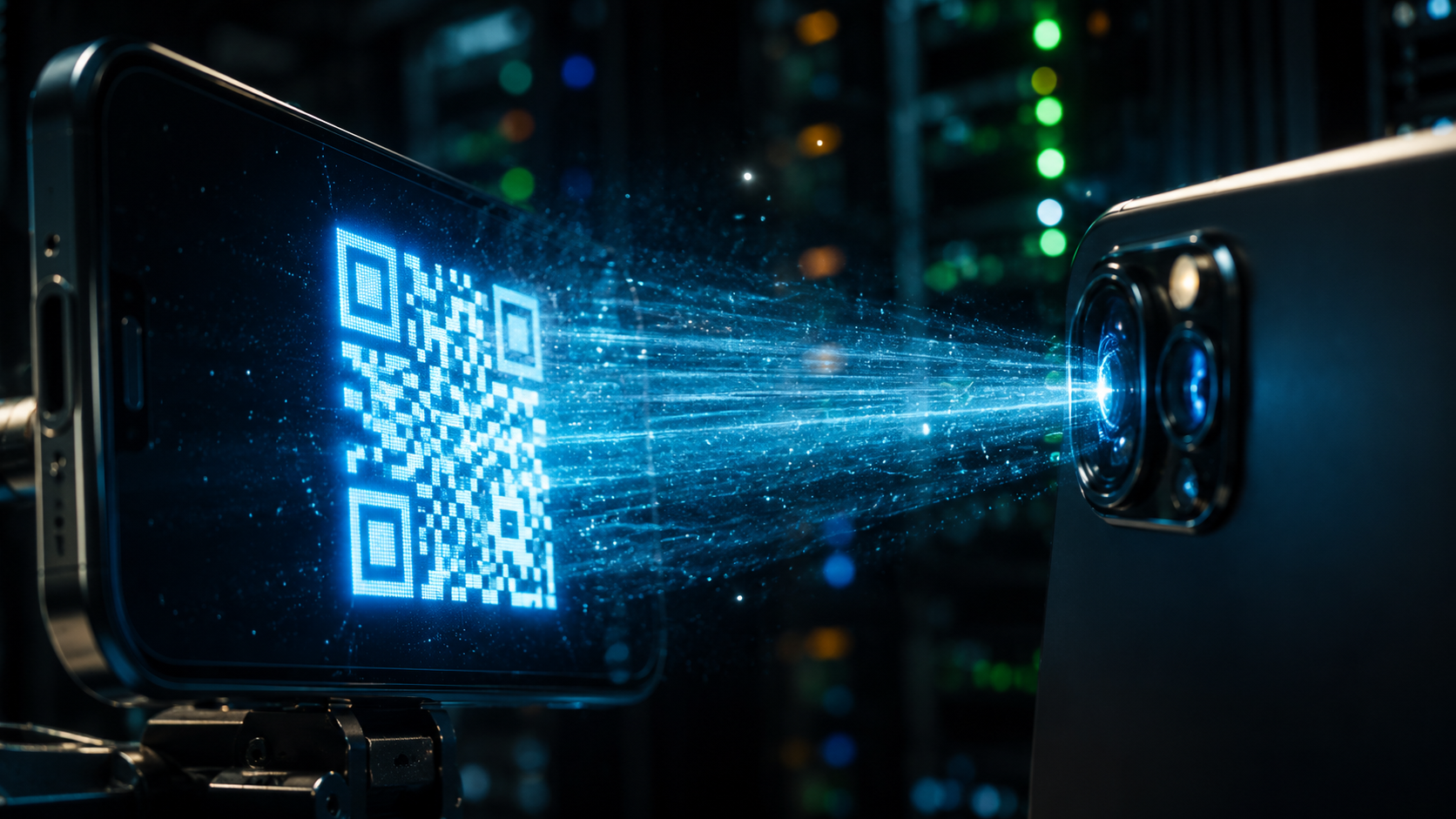
A developer known as Alstroph has unveiled Decimen Optical Transfer, a browser-native system that streams data across screens using rapid optical QR frames, bypassing Wi-Fi, Bluetooth, cellular networks, and physical cables.
Executive Summary and Technical Overview
Moving files between modern smartphones almost universally requires an underlying network infrastructure. Whether relying on local radio protocols like Bluetooth, Wi-Fi Direct, Apple AirDrop, or Android Nearby Share, devices must initiate complex handshakes, negotiate radio channels, and exchange cryptographic keys. When radio connectivity is unavailable, users are forced to rely on cloud services, physical USB cables, or external storage drives.
A developer known as Alstroph (publishing on GitHub under the handle bashalarmistalt) has introduced an alternative approach called Decimen Optical Transfer. This proof-of-concept web application converts arbitrary digital files into an endless stream of rapidly changing QR codes displayed on a screen. A receiving phone points its camera at the display, decodes the visual stream, and reconstructs the original file in real time.
The technology operates without cellular coverage, local Wi-Fi, Bluetooth pairing, dedicated mobile applications, user accounts, or special system permissions beyond standard camera access. By leveraging mathematical concepts known as fountain codes (specifically Luby Transform coding), the system achieves transfer speeds of up to 186 KB/s, allowing a 2 MB file to move across devices in approximately 15 seconds.
People who regularly read latest news online regarding emerging software breakthroughs are taking note of how lightweight, browser-based tools can solve complex networking problems using light alone.
The Core Challenge of Local File Transfers
Modern operating systems offer several built-in methods for transferring documents, photos, and media between nearby devices. However, every conventional protocol carries distinct technical friction points and hardware dependencies.
Radio Channel Interdependence and Pairing Friction
Protocols such as AirDrop and Nearby Share rely on a combination of Bluetooth Low Energy (BLE) for device discovery and Wi-Fi Direct for high-speed data transmission. This architecture introduces several points of failure:
- Protocol Handshake Overhead: Devices must discover each other, broadcast availability, confirm user identity, and establish an encrypted local link before a single byte of file data is transmitted.
- Cross-Platform Incompatibility: AirDrop is restricted to the Apple ecosystem, while Nearby Share (and Quick Share) targets Android and Windows devices. Sending a file directly between an iOS device and an Android phone without an internet connection often requires third-party applications or local Wi-Fi hotspots.
- Environment Restrictions: High-security government facilities, industrial labs, financial trading floors, and secure defense enclosures routinely ban radio emissions. Bluetooth and Wi-Fi signals are strictly prohibited or actively jammed in these locations, making standard wireless transfers impossible.
Physical Cable Constraints
While physical cables provide high transfer speeds, they introduce hardware incompatibilities across lightning connectors, USB-C standards, and OTG (On-The-Go) host requirements. Additionally, connecting an unknown phone to a computer or another smartphone via a cable introduces potential hardware security risks, such as malicious power manipulation or unauthorized data access.
How Decimen Optical Transfer Works: Transmission as Light
Decimen Optical Transfer completely replaces radio frequency signals with modulated light emitted from a display screen. Because light is a one-way broadcast medium, the sender projects information continuously without receiving any feedback from the receiving camera.
The One-Way Channel Problem
In traditional network communications (such as TCP/IP), when a packet is dropped due to noise or congestion, the receiver sends a Negative Acknowledgment (NACK) asking the sender to retransmit the missing data.
In a screen-to-camera optical system, there is no back-channel. The camera cannot send a signal back to the screen requesting a missed frame. Furthermore, optical transmission is inherently prone to frame loss due to motion blur, camera autofocus adjustments, screen refresh rate misalignment, or temporary physical obstruction.
If a system simply loops a sequential file through a series of standard QR codes (Frame 1, Frame 2, Frame 3… Frame N), missing a single frame forces the receiving user to wait through a complete cycle of all remaining frames until Frame 1 appears again. This approach results in frustrating, slow, and unreliable transfers.
Mathematical Foundation: Fountain Codes and Luby Transform
To overcome the one-way channel problem, Decimen Optical Transfer relies on fountain codes, a class of erasure codes designed for broadcast channels.
The Droplet Metaphor
Fountain coding gets its name from a simple physical analogy. Imagine trying to fill a water bucket from a fountain. You do not need to collect specific, numbered drops of water in order. You simply hold the bucket under the spout until you have collected a sufficient volume of water, regardless of which individual drops landed inside.
In Decimen Optical Transfer, the sending screen acts as the fountain, continuously streaming encoded “droplets” of data. The receiving camera acts as the bucket, capturing available frames whenever possible.
Luby Transform (LT) Coding Mechanics
Decimen uses Luby Transform coding, an implementation of rateless erasure codes. The mathematical process operates as follows:
- File Partitioning: The original file is divided into $K$ equal-sized source blocks.
- Degree Selection: For each generated frame, a degree $d$ is chosen at random from a mathematical probability distribution called a Robust Soliton Distribution.
- Subset XOR Combination: The encoder randomly selects $d$ distinct blocks from the original $K$ file blocks and combines them using a bitwise XOR (exclusive OR) operation.
- Self-Describing Frame Generation: The resulting XOR payload is packaged with a lightweight header and rendered as a QR code.
When the receiver captures a frame, it does not receive raw file segments directly. Instead, it receives an encoded combination of multiple segments.
Peeling Decoder Algorithm
On the receiving side, a peeling decoder process works backward to reconstruct the original data:
- Whenever the receiver captures a frame with a degree $d = 1$ (containing a single, un-combined block), that block is solved immediately.
- The solved block value is then XOR-subtracted from all other stored frames that contain it, reducing their degree count.
- This subtraction triggers a cascade of newly solved blocks across the receiving matrix.
Because every frame is self-describing, the receiver can start capturing the optical stream at any point. It does not matter if the camera misses ten frames due to a hand tremor or autofocus delay. Once the receiver collects approximately $1.15 \times K$ unique frames, the peeling decoder cascade completes, restoring the entire file.
Detailed Software Architecture and Frame Structure
Decimen Optical Transfer was designed as a zero-install, browser-native web application built with modern web technologies, including TypeScript, Vite, WebAssembly (WASM), and Web Workers.
Self-Describing 20-Byte Header
To ensure seamless synchronization without a preliminary network handshake, every generated QR frame carries a compact 20-byte binary header.
- Session Identifier (4 Bytes): Distinguishes between different transfer streams. If the sending device switches files or restarts, the session ID changes, signaling the receiver to clear its current decoding matrix automatically.
- Sequence Number (4 Bytes): Serves as a deterministic seed for the pseudo-random number generator on both ends. This allows the receiver to derive the exact combination of blocks encoded inside the frame without sending a block list.
- Total Block Count & Block Size (6 Bytes): Defines the dimensions of the decoding matrix.
- Total File Length & Verification Hash (6 Bytes): Provides file metadata and integrity checks before rendering.
Adaptive Payload Compression and Container Structure
Before rendering frames, Decimen evaluates the input payload:
- Adaptive Gzip Compression: The software calculates whether compressing the file reduces its optical footprint. If Gzip compression decreases the total byte count, it is applied automatically; otherwise, the raw file is processed to avoid unnecessary CPU overhead.
- File Container Metadata: Filename, extension, and MIME type are preserved directly within the fountain stream header, allowing the receiver to offer an accurate file download upon completion.
- Integrity Hash: Once the peeling decoder completes the matrix, the app calculates a SHA-256 hash of the reconstructed file and compares it to the source hash carried in the stream. The user is presented with a download prompt only after hash verification succeeds.
Overcoming Complex Browser and Hardware Desynchronization
Building an optical data link inside a mobile web browser presents significant technical challenges. Devices running different operating systems, browsers, and camera hardware introduce subtle performance variations that can disrupt data transmission. Alstroph solved several of these edge-case issues during development.
Deterministic Logarithm Calculation Across JS Engines
Fountain code encoding requires both sender and receiver to build identical Robust Soliton probability distributions. However, different JavaScript engines (V8 in Chrome versus JavaScriptCore in Safari) handle standard math functions like Math.log() with slight differences in floating-point precision.
Even a tiny floating-point variance causes the sender and receiver to derive different block combinations from the same sequence number, resulting in total decoding failure. To prevent this, Decimen includes a custom, deterministic logarithm function built with exact IEEE-754 bitwise operations, ensuring bit-identical distribution matrices across all browser engines.
Handling iOS Camera Constraints
When requesting camera capabilities on iOS devices, the WebKit implementation often silently falls back to 30 frames per second when queried with standard constraints such as frameRate: { ideal: 60 }. Decimen explicitly enforces { exact: 60 } at a 1280×720 capture resolution, falling back gracefully only when hardware limits require it, ensuring optimal frame capture rates.
Multi-Threaded Web Worker Decoding
Because Safari lacks native support for the experimental BarcodeDetector API, Decimen bundles zxing-cpp compiled to WebAssembly (WASM). Decoding 60 visual frames per second in high resolution can overwhelm a single CPU thread. Decimen delegates decoding tasks across multiple Web Workers using the browser’s requestVideoFrameCallback API. If a worker falls behind during heavy frame bursts, dropped frames are simply absorbed by the fountain code layer without stalling the user interface.
Transfer Speeds and Operational Benchmarks
The real-world throughput (or goodput) of an optical file transfer depends on screen refresh rates, display density, camera resolution, ambient lighting, and device stability.
Measured Real-World Goodput
- Handheld Transfer Mode: When holding both phones in hand under ambient indoor lighting, the optical link achieves sustained transfer speeds between 128 KB/s and 129 KB/s.
- Stationary Propped Mode: When both devices are resting on a stable surface (eliminating motion blur and distance fluctuations), the capture pipeline achieves goodput speeds between 186 KB/s and 190 KB/s.
- Payload Scaling: At standard handheld speeds, a 512 KB document transfers in approximately 4 seconds, while a 2 MB high-resolution image finishes in about 15 seconds. The PoC repository supports arbitrary files up to 64 MB.
Real-World Use Cases and Security Applications
The ability to move digital files using only light opens up valuable practical applications across several technical and operational fields.
Air-Gapped Secure Enclosures
In high-security environments, such as defense research centers, server vaults, and industrial control facilities, wireless radio signals (Wi-Fi, Bluetooth, cellular) are strictly prohibited to prevent unauthorized remote access or signal eavesdropping. Decimen Optical Transfer enables air-gapped data delivery without violating physical RF bans or requiring physical cables.
Disaster Relief and Off-Grid Operations
During natural disasters, cellular towers and power grids are often disrupted. Emergency responders and civilians stranded in off-grid locations can share maps, medical guides, and identity documents between phones without cellular coverage or local network infrastructure.
Cross-Network Document Transfer
Corporate environments often enforce strict separation between internal office networks and guest Wi-Fi segments. Moving a file from a guest laptop to a employee phone typically requires sending an external email or using cloud storage. Decimen allows users to display the file on the laptop screen and scan it directly onto the phone, bridging isolated network segments instantly.
Comprehensive Protocol Comparison
The table below contrasts Decimen Optical Transfer with traditional wired and wireless data transfer solutions.
Security Analysis and Threat Modeling
While optical data transmission offers distinct privacy benefits, it also introduces unique physical security considerations.
Privacy and Air-Gap Security Advantages
- Zero Network Footprint: Decimen does not register on local network routers, firewalls, or packet inspection tools. No data packets pass through local Wi-Fi or cellular gateways.
- No Transceiver Handshakes: Because the receiving camera does not emit radio signals, the transaction leaves no detectable RF signature in the surrounding radio spectrum.
- Minimized Permission Surface: The web application requires only camera access. It does not request local storage permissions, location tracking, device IDs, or contact list access.
Line-of-Sight Vulnerabilities and Risks
- Visual Eavesdropping: Because data is transmitted as light emitted from a screen, any secondary camera or observer with a clear line of sight to the display can record the optical stream and decode the file independently. Physical privacy shields or obscured angles are necessary in public settings.
- Data Exfiltration Vectors: High-security organizations that rely on physical air-gaps must account for optical channels. An authorized screen displaying rapidly flashing patterns could potentially be recorded by a nearby camera, serving as an optical exfiltration route for sensitive information.
Development Context: AI-Assisted System Prototyping
An intriguing aspect of Decimen Optical Transfer is its rapid software development timeline. Alstroph built the functional proof-of-concept overnight using Claude Code, an AI coding assistant developed by Anthropic.
The Role of AI in Complex Systems Engineering
While open-source projects like Divan’s txqr explored fountain-coded QR transfers in 2018 using native Go code, Decimen brings the concept directly into modern web browsers without installation.
Using Claude Code, the developer rapidly iterated through mathematical distributions, Web Worker thread scheduling, and cross-browser camera constraints, turning a theoretical protocol concept into a functional, inspectable web app in a single night. This demonstrates how AI development tools allow software engineers to rapidly prototype complex systems that combine advanced mathematics, browser APIs, and high-performance WebAssembly.
Related Article’s:
- Detailed Analysis of the Meerut Shooting Incident and Broader Public Safety Dynamics
- Five-Year-Old ‘Suicide’ Case Solved After High Court Orders Fresh Probe, Bihar SIT Arrests Two
- Devar (Brother-in-law) Allegedly Beheads Sister-in-Law After Argument While She Was Serving Food in Bihar’s Jehanabad
- Iran Publicly Executes Two Men Convicted Over January Protests
- Ghaziabad Teacher Alleges Rape, Blackmail, Forced Conversion Pressure
- Third Husband Murdered in Alleged Plot for Fourth Marriage: MP Police Arrest Wife, Alleged Lover and Associate
- Supreme Court Cancels Sonam Raghuvanshi’s Bail in Raja Raghuvanshi Murder Case, Orders Surrender Within Three Weeks
- Australian Woman Arrested for Killing and Allegedly Eating Her 4-Year-Old Child
Frequently Asked Questions (FAQ)
What is Decimen Optical Transfer?
Decimen Optical Transfer is an open-source, browser-based file transfer application that converts digital files into a rapid stream of QR codes displayed on a screen. A receiving phone uses its camera to capture the visual stream and reconstruct the original file without relying on network connections.
Does Decimen require an active internet connection or Bluetooth?
No. Once the web page loads on both devices, the app functions entirely offline. You can turn on Airplane Mode and disable Wi-Fi, Bluetooth, and cellular data while continuing to transfer files.
How does the system handle blurry, out-of-order, or missed frames?
Decimen uses Luby Transform fountain codes. Instead of sending sequential file blocks, every frame contains a random XOR combination of file pieces. Because every frame is self-describing, dropped or blurry frames do not disrupt the process. The receiver simply needs to capture a sufficient number of distinct frames to reconstruct the complete file.
How fast is the optical transfer speed?
In handheld testing, Decimen achieves transfer speeds between 128 KB/s and 129 KB/s. When both phones are propped up stably, speeds reach up to 186 KB/s. A typical 2 MB image file takes roughly 15 seconds to transfer.
Do I need to install an app or create an account to use it?
No. Decimen runs directly inside standard mobile web browsers (such as Safari or Chrome). It requires no app installation, account registration, or system permissions beyond camera access.
Is Decimen safe to use for sensitive data?
Decimen operates entirely locally within the browser, meaning no data is uploaded to remote cloud servers. However, because the file is displayed as a visual stream of light on a screen, anyone with a clear physical view of the display could potentially capture the stream. Users should ensure physical screen privacy when transferring sensitive information.
Follow Us On Social Media:
[latest news today, world news, latest world news, world latest news, world news latest, latest news world, iran latest news, latest iran news, iran news latest, iran news, latest news iran, world cup latest news, latest ai news, fifa world cup, fifa world cup 2026, war latest news, latest war news, war news latest, india latest news, latest news india, us iran news latest, latest news iran war, iran us latest news, us iran latest news, iran us news latest, iran war news latest, iran war news, trump news latest, iran war latest news, latest iran war news, trump latest, latest trump news, trump latest news, trump news, latest transfer news, latest world news today, latest hindi news, uk latest news, latest uk news, latest news uk, latest football news, latest news on iran, latest news in hindi, us iran war latest news, iran us war latest news, iran latest news today, us iran war news latest, ukraine latest news, latest ukraine news, wikipedia, latest news on us iran war, latest news on iran us war, us iran war latest news, iran us news latest, iran us war latest news, iran us latest news, latest news iran war, us iran news latest, us iran war news latest, us iran latest news, iran war news, iran war latest news, iran war news latest, us and iran latest news, latest news on iran war, iran latest news, latest iran war news, latest iran news, iran news latest, iran war latest news today, latest news on iran, gift nifty live, latest news iran, gift nifty, iran news, latest war news, war latest news, latest news on war, war news latest, iran latest news today, iran israel war latest news, crude oil price, al jazeera latest news, brent crude price, nifty 50, sensex today, trump news latest, latest trump news, trump latest, trump news, trump latest news, man u latest news, trump latest news today, manchester united latest transfer news, man utd latest transfer news, latest trump news today, wikipedia, chelsea latest transfer news, www electronmagazine .com latest news, manchester united latest news]






2 comments